
 We celebrate Labor Day tomorrow, a national holiday honoring the Labor Union Movement and the contribution of workers to our country. But we all labor in different ways, unionized or not, and it is good to consider the place of work in our culture.
Work may be defined in many ways. There’s working to pay the rent and put food on the table. There is volunteer work, actively helping others without payment. A mother’s work is never done, it is said, and probably true. Most of us wake with the first cry of our children and work for their well being on and into the night. They may grow up and leave home but will always be our children. We will always be their mothers. And so it ever shall be.
There is the work of those lucky few who have found joy in their calling, especially those who are paid to do something they love. They reap envy from others, but they too have their long hours of toil, one disciplined step at a time.
I have found it interesting that the Women’s Movement was begun by ladies of leisure, graduates from Ivy League colleges, women with time on their hands. They had no meaningful work. Nannies cared for their children. Cooks cooked and housekeepers kept house. What’s a girl to do? It was inevitable that ladies’ lunches and charity bazaars would bore some women. They wanted to be rewarded financially, for their brains if not their brawn. They wanted recognition in the “real” world. Somehow raising children wasn’t real, when they didn’t do the raising. I can see that.
As feminism swept the country, the women in my family were swept along with many others from the modest middle class. A woman without a career was somehow weak or silly or dimwitted. Eventually and with some reluctance, being a homemaker was accepted as acceptable, or at least lip service was paid. And so families, already fraught with the natural tensions of human beings living under one roof, without maid, cook, or nanny, felt additional pressure to meet unreal expectations, to “have it all.”
Feminism has benefited our world in many ways; equal pay for equal work, and greater respect for women, have been a welcome revolution.
But the desire of the wealthy to head off to work says something about basic human needs. We are wired to create, to build, to move from beginnings to middles to ends. To produce and achieve. Medieval monks knew this, laboring in those secluded houses of unceasing prayer, for their hours of prayer alternated with hours of work – ora and labora, as St. Benedict decreed. Their labor, their toil, was often tedious, to be sure, in fields and farm, digging, planting, harvesting. Monastics in more cloistered orders prayed in solitary cells, but they saw prayer itself as a kind of work. Their words to God were not turned inward as found in Buddhism or Hinduism, but outward, to the Christian God of love, as they meditated on his Incarnation, Passion, and Resurrection. All Christian prayer has a goal within it that pulls one outside oneself – praise, petition, confession, intercession, thanksgiving. In this sense prayer is a work in itself, a beautiful work for God.
A tradition grew within Christianity of prayerful work, labora full of ora, work full of prayer. We offer our work to God, our time, ourselves, minute by minute. We infuse our work with the holy. Secularists have borrowed and renamed the idea, calling it “living in the moment” or “mindfulness”. But Christians have practiced this for centuries. In a world created by God, all creation, all time, is holy, and even our breathing can be infused with God’s spirit. A prayer-full friend taught me to breathe Jesus in and out, Je in and sus out, pulling God into our very breath, the breath that he breathed into us in the Garden. Now we hear from therapists to remember to breathe deeply, to relax.
Work structures our time on earth and gives it meaning, even if only for an hour. It structures our minds as well. We discipline ourselves to go to work, to labor and toil, to make the effort to sit down and work, say, to write this blog. In the discipline itself, my mind is slightly changed, remade. My brain has been strengthened, sculpted, for the next work challenge. And my time has reaped rewards. I have no regrets.
We say a woman giving birth goes through labor. It is a life-giving work, God-like in its power and its love. For the woman must suffer in this labor, must breathe and push and give of her body to allow this new life, this child within her, the chance to breathe as she has been given. It is the most glorious and important and cosmic work of all, a true labor of love. It would be good for our culture to one day honor such labor. It would be good to tell the truth about mothers and their unborn babies. Every woman giving birth should be especially honored. I pray for that, and that is another labor of love.
Since the Garden of Eden, when man was sent into the world to work, we have toiled for our living. And yet, through grace, our loving God pours himself into our labor.
We need merely breathe him in and he will turn our work into his glory.
 There is one quality the two candidates running for President of the United States have in common: their wealth.
 Man is a curious combination of opposites, desiring both community and isolation. The distance we keep between one another is a function of many factors, but our relationships have always been complicated. Even that closest connection – mother and child – is fraught with distance varying in time, in place, beset by darkness, illumined by light.
 The children were eager this morning to be photographed with their pink and green pails under the window in our bright Sunday School room. Natalie, age six, stood on one side of the planting tray, her head tilted like an elfin faerie, and Luisa, age four, stood on the other, devoutly serious.
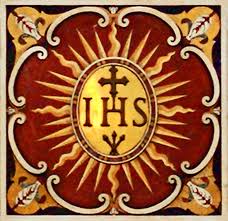 Today traditional Anglicans celebrate the Feast of the Holy Name of Jesus.
 We celebrate this Holy Name of Jesus on August 7, the day after the Feast of the Transfiguration. The closeness of the festivals is appropriate, for it is on Mount Tabor that Jesus reveals himself as God’s Son once again, reflecting his own Baptism:
 ething happens in the Mass.
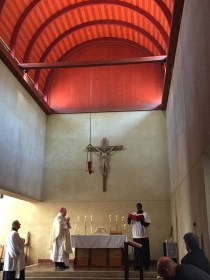 The organ is played on Sundays. It wasn’t played in the weekday Masses, but then we had melodious singing. The postulants, discerners, and clergy, robed in black, entered in silence, into the silence, and took places along benches lining the walls. Rug squares served as kneelers on the polished tiles. As the Mass danced its way through the Lessons, Creed, Absolution, Offering, Consecration, and Communion, the congregation sang responses, sang the Gloria and the Creed, sang hymns with one voice or in harmony. There were quiet “said” Masses too, spoken only, Masses mourning recent Christian martyrs, words full of reverence and love, and longing for a world at peace not war. And each Mass, celebrated by a different priest, was unique, reflecting the celebrant’s unique manner and character.
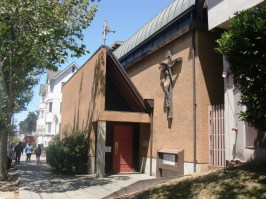
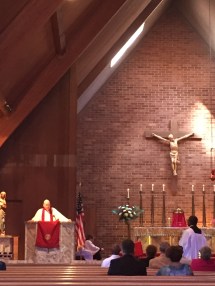 This last week I spent in seemingly alternating universes, attending daily Mass at our Anglican Seminary Summer Session at St. Joseph’s Chapel in Berkeley at mid-day, and then watching the GOP convention in the evening. The former was quiet, focused, purposeful, and passionate. The latter was lively, energetic, excited, and passionate. The convention was the body politic that exercises freedom of speech and assembly, a gathering of devoted delegates to nominate the next President. The Seminary Summer Session was the body ecclesia that exercises its freedom of religion and worship, a gathering of devoted clergy, postulants, and men discerning their vocation.
 Beware and be aware of the desire to be squeaky clean, to cleanse our culture of people we don’t like. Beware and be aware of the desire to cleanse history of facts, to rewrite the American story.
 I celebrated my sixty-ninth birthday yesterday, and so I was particularly happy that today I found myself singing with the children in Sunday School, “I sing a song of the saints of God…”
 My husband and I are usually early to Mass, early to everything for that matter. This morning was no exception as we entered the spacious nave of our local parish church.
 Christine Sunderland
 Christine Sunderland