Category Archives: Uncategorized

March Journal, Passion Sunday, Fifth Sunday in Lent

AMERICAN FLAGIt has been said that America is a nation of immigrants. Why did they come here? Why do they continue to come?

To be sure, we need them. Our population is shrinking since the pill and legalized abortion. We are a people who prize the individual at the expense of the family, at the expense of authorities of all kinds. And now we are paying the price, with a surge of aging boomers requiring care, reaping our childless past. We need workers to settle in our country and take care of the boomers.

But we need immigrants to enter legally. We need to protect our country from drugs and human trafficking and Coronavirus, from foreign agents seeking to harm us. We need legal immigrants who desire to become Americans, who cherish freedom, abide by our laws, and speak our language. We need them to respect our history and our institutions, especially our religious institutions.

Especially the First Amendment to the Constitution, the free speech amendment:

Congress shall make no law respecting an establishment of religion, or prohibiting the free exercise thereof; or abridging the freedom of speech, or of the press; or the right of the people peaceably to assemble, and to petition the Government for a redress of grievances.

Clearly we should be allowed to express our beliefs and opinions without fear. Clearly we should encourage civil debate. And yet today opposing opinions are forced underground. In the wake of the rise of this totalitarian terror we are self-censoring, and this has been the most dangerous development of all (see a recent Epoch Times discussion of this frightening phenomenon: “Communist Tactics to Force Self-Censorship Sweeping America” by Petr Svab, March 9, 2021)

What this means for writers of all genres is that publishers will be even more hesitant to risk the anger of the mob, risk subscription counts, risk employment, risk livelihoods, risk life and limb.

The rush to cross our southern border is only equaled by the silencing of any objection to illegal immigration, and thus the silencing of law and order, the Constitution, the history and culture of our country.

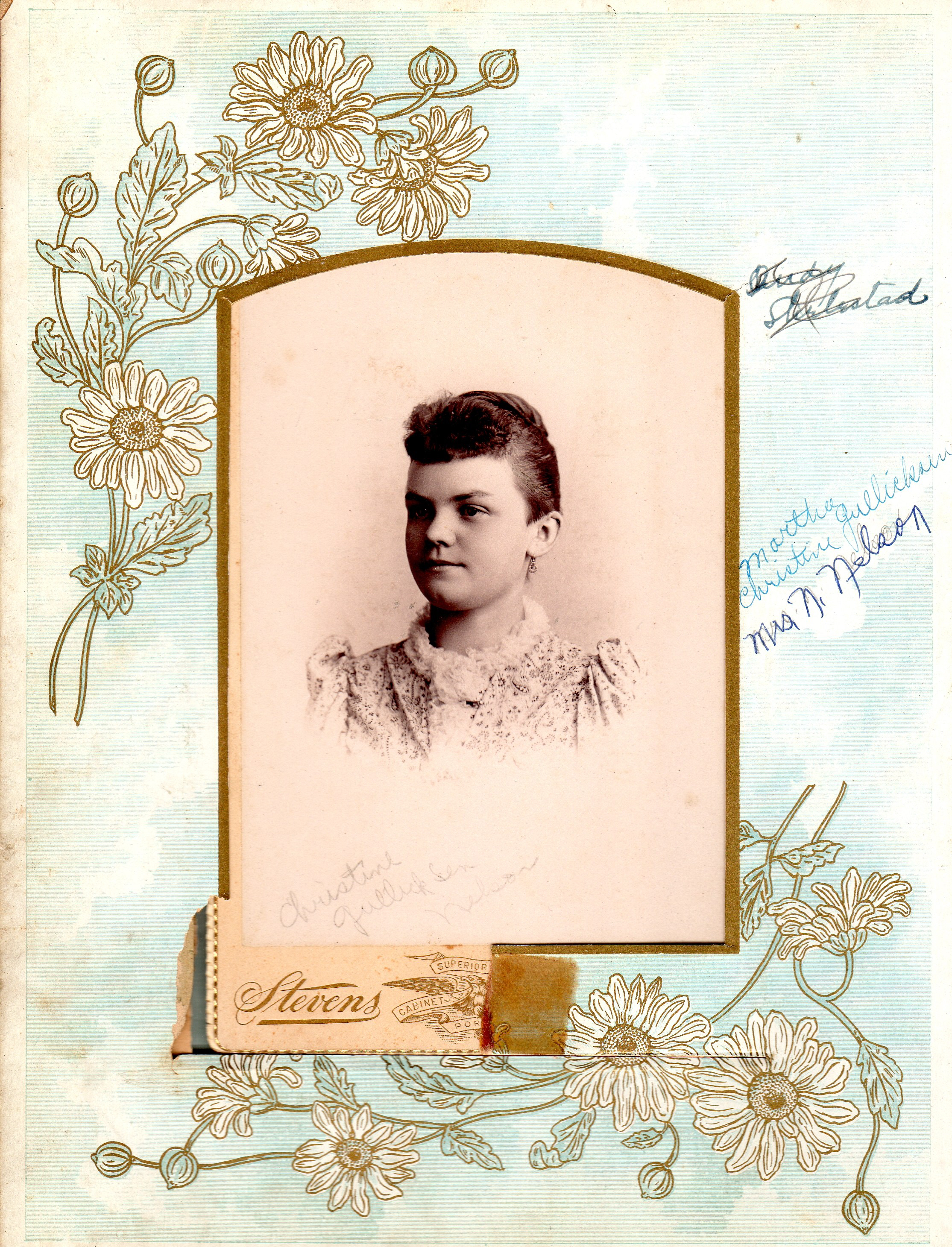
Gulicksons.Christine (Nelson) Gullickson, lower rightMy family immigrated from Norway and I have recently been researching some of the details. Each fact carries within it another question, why this, why that, what caused them to leave and come to America?

The Nielsens and the Gullicksens knew each other for many generations in the farming community of Solum, Telemark, Norway, before they immigrated to America, before Nicholas Nelson married Marta Kristin Gullicksen in 1892 in Chicago. Their families had been farmers, and all were baptized in the local Solum church.

Why did they leave to risk the long sea journey to our shores? The Gullicksens traveled with four young children. It is my guess they only spoke Norwegian. And it is my guess they wanted a better life. They became Americans. They worked to assimilate, to become part of their new community of Chicago, part of their new country, America. They learned the language, and they even anglicized the spelling of their names. Marta Kristin became Martha Christine. Nielsen became Nelson. Gulliksen changed as well over the years. They desired to share this land with other immigrants, those who came before and those who would come after.

I believe also they entered legally, probably through Ellis Island (will research that at some point). How did they arrive in Chicago, after coming into New York City? The Nielsens came first in the 1860’s. The Gullicksens arrived two months before the Great Chicago Fire of 1871. Somehow they survived.

They were fearless and full of faith; their faith made them fearless or at least fearing what should rightly be feared. They knew right from wrong, according to the law of Moses, fulfilled by Christ, and they taught their children these values of hard work, honesty, kindness. Love your neighbor. Do unto others as you would have them do unto you. Examine your own life for sin and repent and start over. Obey and honor God.

Martha Christine Gullickson Nelson (1870-1949)Martha Christine (photo to the left) married Nicholas Nelson in Chicago in 1892. Their three children were born in Chicago in the years following. But at some point they left for Denver. Why? Nicholas, like his brother-in-law Ole Gullicksen (see earlier blog), founded a company in Denver.

Ole founded a furniture manufacturing company, The Churchill Cabinet Company in 1904 in Chicago. Nicholas founded the Nicholas and Rhodes Candy Company in Denver. It was listed in Denver in 1914-15 when it became a member of the Confectioners Association.

Their three children grew up in those years, mainly in Denver. My grandmother, Helen Christine Nelson, married James Headlee Martin in Denver in 1919.

And in 1920 my mother, Helen Martha Martin, was born, followed by Mary Ruth Martin in 1921. Headlee worked for Texaco and in the next few years was transferred to Spokane, where Lucy Jane Martin was born (1927). A few years after that, concerned about the moral ethos of the company at the time (according to my mother), Headlee quit and the family made their way to the West Coast and took a steamer to Los Angeles.

Ole stayed in Chicago along with many relatives. But my branch of the family were travelers, immigrants within the nation as it were, looking for something else, or forced to look, or ? Norway-Chicago-Denver-Spokane-Los Angeles. In each generation, a child, now grown and married, pulled up roots to plant somewhere else.

They embodied a frontier optimism so characteristic of America. They traveled from Norway, conquering land and language and law and labor. They survived the fire in Chicago, and the next generation moved to Denver to make their fortune there. Then following the spirit of the growing economy, the next generation went to Spokane, where Headlee made a principled decision, to stand up for what he believed, quitting his job. The sacrifice placed them in the Depression with no livelihood.

candleI have cobbled this story from bits and pieces and welcome family members’ corrections. As a novelist I am fascinated by human character, the depth and variety of created humanity, no two persons alike. As a Christian novelist I am fascinated by conscience, formed and informed by Christ. When this fiery spirit resides within, it burns brightly and enlightens our decisions. When this spirit is put out or ignored or denied, choices are made in moral darkness, with only concern for the self.
It is this debate between the light and the dark that is being silenced today. The fire of freedom that burns within every American is being snuffed out like a candle burned down to its last bit of wax.

We are a country of immigrants, of travelers, of creators, of doers, a people of imagination and energy. Let us protect this heritage and keep the flame burning, that fire of the first amendment, promising free speech, free assembly, freedom to practice religion, freedom to petition for redress of grievances. Let us continue to be a beacon to the world, a light in the darkness of tyranny.

Today is Passion Sunday, the beginning of the passio the last days of Christ on earth. The light of the world becomes dark only to rise again to new life and light. America celebrates this grand passion and welcomes all to celebrate with her this great gift of freedom and the promise of eternity.

March Journal, Fourth Sunday in Lent


Martha Christine Gillickson NelsonAs I was gazing upon some old, framed photos of ancestors on one of my bookshelves and quizzing myself on their names, whether they were the English or Norwegian branch, I noticed some volumes of autobiography near the photo of my great grandmother, Martha Christine (Gullicksen) Nelson. They were slim volumes, about 4” X 6”, hardbound dark blue, and titled Little Masterpieces of Autobiography. The first of four volumes was subtitled Greatest Americans and included Washington, Jefferson, Hamilton, and Lincoln. The volume was edited by George Iles and first published in 1885, but this edition was dated 1925, published by Doubleday, Page and Company in New York. They were part of a collection given to me by my grandmother Helen Christine (Nelson) Martin (1896-1994).
The books renewed an interest to learn more about these Norwegians who came to Chicago from Telemark, Norway in 1871.

I have been thinking of including an American history theme in my next novel, and I realized I could use this slim volume of Great Americans as research as I explored my own immigrant roots in Chicago.

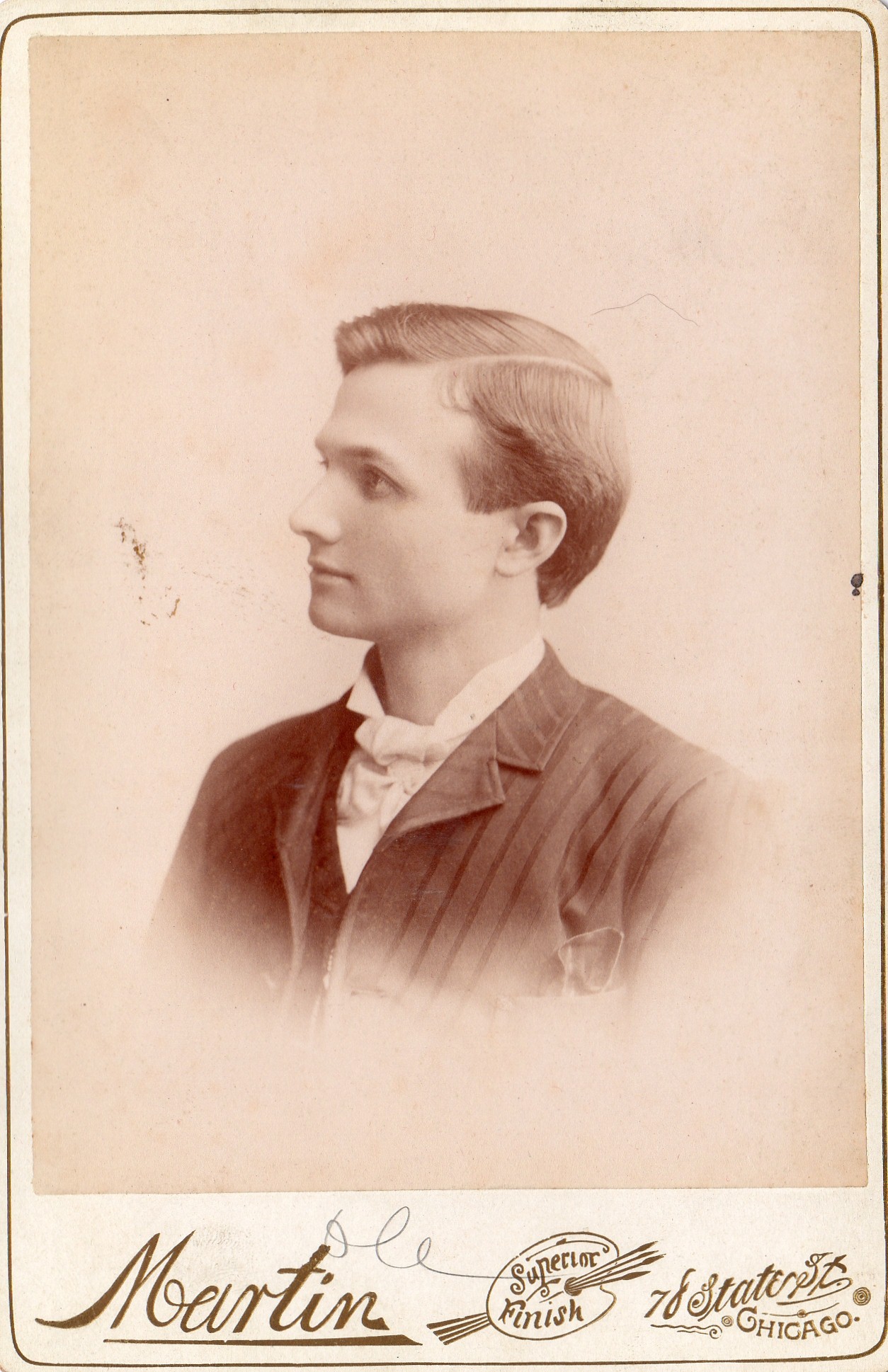
Ole Gullickson (C's Brother)I had heard via family lore that one of these ancestors founded a furniture company in Chicago. I opened an old file where I had placed bits and pieces given to me over the years, notes and jottings penned by my grandmother Helen Christine and my great grandmother, Martha Christine. From these bits I learned that Martha Christine’s brother, Ole Gullicksen (1867-1948), founded the Churchill Cabinet Company in Chicago in 1904.

A quick online search revealed the company was still in business, refashioned to construct pinball cabinets when forced to compete with lower priced mass-produced furniture. The business, named after the original location (Churchill Street), had moved a few blocks southwest.

I can see why folks love to research genealogy. It’s like a jigsaw puzzle, and each piece added is a great discovery.

I soon learned that Ole became a successful entrepreneur, helping to fund the Norwegian American Hospital near Humboldt Park. I also learned sadly that the hospital is in the process of changing the name to Humboldt Park Health to better reflect the community – a sign of the times, the rebranding, the renaming, the cancelling and erasing.

There are those today who wish to erase our history, topple our great Americans, as if to reinvent our country and reform our union. But it is history, true history, that defines us as individuals and as nations.

Churchill Cabinet CoLooking at these Norwegians that came before me enriches my life today. I know there are many other strands from other countries that wove together to make me me, and I marvel at God’s intricate and beautiful (if also mysterious) ways. These threads of life continue into the future, and I smiled when I saw that my grandson is attending a college not far from Churchill Street: Wheaton. When I saw Naperville nearby, I recognized it was the location of one of our APCK (Anglican Province of Christ the King) parishes, All Saints.

The glories of the past – and the inglorious – all affect the present and the future.

And so as we celebrated this morning the Fourth Sunday in Lent, the lessons reverberated with these themes of identity, who we are as Christians in this long journey through time. We travel the path of faith, reliving the journey God lived among us, beginning with Abraham and fulfilled in Christ. We travel with and within the Church through these celebrations each year. We live out the past in the present so that we can live in the future. We teach our children how to do this. We teach them to never forget who they were, are, and will be.

In this way my immigrant ancestors added to the stream of Christian witness. They taught us how to become Americans – through a common language, through hard work, through a strong family life, and through a devout faith.

I wish I had known them. With research, I will know a little more. But I will know them one day more than a little, one day in the Heavenly Jerusalem.

March Journal, Third Sunday in Lent

In the Gospel reading assigned for today, Our Lord’s words rang especially true: “Every kingdom divided against itself is brought to desolation; and a house divided against a house falleth.” (St. Luke 11:14+) America is divided by the politics of division itself.

It is tragically ironic that we are told we must return to a segregated society, and the call to make this happen has come from those who championed southern segregation and the ownership of slaves, the Democrat Party. 

The work of Martin Luther King and many others up to this day is being abandoned and denied. We are being separated into groups by the color of our skin. We are being told what to think and how to act according to rules of race.

This tyranny goes by the name of critical race theory or identity politics. Instead of restoring identities and celebrating our differences, powerful groups seek to foment war between races.

Those who seek to bring Americans together through common language, history, and idea,  to celebrate diversity, the many cultures that have enriched our country, are deemed racists, haters, and even terrorists.

As an Anglican, I have been part of congregations of mixed race and heritage. The Anglican Church, stemming from Britain and her Commonwealth, was and is a universal church, finding its way to Asia, India, Africa, and the Americas. We have members and clergy from all parts of the world. The native culture learned English as well as the Gospel message of salvation, but Bibles were translated into their own language as well. All this continues.

We celebrate an individual’s talents, gifts that will make our parish life vibrant.

And it is the common faith, common language, and common history as freedom-loving Americans that has made this globalism within a parish family thrive. It is Christianity that has brought freedom to those enslaved, whether chained by sin or by man.

Today I fear there is legislation by decree that threatens our wonderful melting pot. There is also a silencing of those who object, a silencing carried out by powerful interests joining to solidify their power: big business, big tech, big media, big government, big trade unions. These sectors use the politics of division to silence objections to twenty-first segregation and enslavement that they see as beneficial, at least to their own sector. 

For when speech is silenced, debate dies, respect for others, their opinions or skin color or belief system, turns into hatred and demonization. When academia becomes the training ground for groupthink, and fear of reprisal keeps students and faculty in lockstep, the next generation will march to the same tune, wear the same uniform, think the same thoughts. The boot in the face associated with dictatorships is near.

One hopes for the voiceless to find their voices, to stand up when they are told to fold, to hope when they are told to despair, to light the darkness of our world.

Christians understand freedom and its importance to practicing their faith of freedom. We have sent missionaries to their martyrdoms for centuries in the name of the faith and in the name of freedom to practice that faith. We understand objective truth and are attuned to slippery lies. We are trained in logic through theology and apologetics (even the Nicene Creed), in language through Holy Scripture, the ultimate Word, and in joy through experience of the holy, the divine, the eternal in sacraments, liturgy, and prayer. We understand the nature of love and its expression, sacrifice. We submit to Love’s demands in the Ten Commandments, the cardinal virtues, the fruits of the spirit, the Beatitudes. Amidst the chaos and suffering of this world, we see a greater good and we look to a greater Love when Christ leads us into the Holy City, the New Jerusalem. We know and grow to fully understand that this life is but a prelude to one of immense joy, but also justice.

We also see clearly that our present world must follow a similar path, live by a similar rule, be part of a similar hope, that the Judeo-Christian rule of righteousness, sometimes called natural law, gives order, secures peace, encourages individual dignity, and celebrates the sanctity of life.

We are told by powerful interests to erase the past, ignore or rewrite history to suit those in power. This is not our way. This is not the way of truth, of healing, of peace. Rather, history that celebrates freedom and human dignity in its heroes is a history that unites us. We must learn from our past, the rights and the wrongs.

We are told by powerful interests that speech must be controlled. This is not our way. This is not the way of artists, of writers, of painters, of musicians. This is not the way of beauty. This is not the way of celebrating the sanctity of every person made in the image of God.
It is a time for truth-telling, for honoring America’s promise, for hope that burns in Lady Liberty’s torch. It appears that it is a sputtering flame, a flame that all the world is watching carefully. For America is an exceptional land, one we cannot take for granted. America needs us, needs our words, our prayers, our love of one another. Liberty’s flame must burn bright.

February Journal, Second Sunday in Lent

It is a curious thing that the most beautiful season in the hills east of San Francisco usually coincides with Lent, a penitential time. The hills surrounding our house are a deep green from February through May, if we have enough rain. By Memorial Day the green grassy slopes dry to a golden brown until next year’s watering.

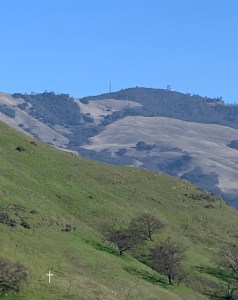
Angel Mountain, aka Mount Diablo, rises behind our house, and the white cross on its flanks stands bright against the green. Beyond the cross, the mountain rises to meet the sky, today a brilliant blue, the air blown clear by a brisk breeze.

Lent is a time of waiting and watching, the new year leaving winter behind and looking to spring. It is also a time of healing, of reconciling the accounts of our lives. As we did with New Year’s resolutions, we reflect on the path we have traveled and consider whether we have lost our way. We repent our wrong choices. We confess them to our Creator, to our Savior, with true tears.

The tears we cry water the brown parched places of our heart, like spring rains. We are watered with our own remorse, in hopes the promise is true – that we are forgiven when we repent, that we are forgiven when we forgive others who repent: “Forgive us our trespasses as we forgive those who trespass against us,” Our Lord told us to pray.

Can there be forgiveness without repentance? I think not. “Go and sin no more,” Jesus commanded. And so we find the right path through the hills to the mountaintop intersecting the sky. We find the straight and narrow path of righteousness, led by the Shepherd whose voice we have come to know.

One of our preachers this morning (I tuned in to three liturgies and am becoming a sermon junkie) made the remarkable observation that we are to pray to God forcefully with no hesitation, as the Canaanite woman did, begging, in the Gospel today. We too are to ask as she did, arguing that even the dogs eat the crumbs from their master’s table. And indeed, she was forceful in her tone. When we petition God, we nearly demand, as the Psalmist does, crying out to God for help and healing and protection. Indeed, in The Lord’s Prayer, the model given to us by Christ Himself, the direct requests are clear: Give us, forgive us, lead us, deliver us. Our preacher said that in this way we get God’s attention. In this way He sees us, and we become sanctified as we travel through our time on Earth because He sees us.

All we do in the liturgy, all of our work we can call good, is for a simple reason – to be seen by God, to be sanctified. And as we are seen, we see.

We were blind, and now we see. It’s really not that complicated, the preacher said. God is our Father, and He loves us. He wants a relationship with us through His Son. And so we include in every prayer, “In the name of Jesus, Amen” as Christ told us to do. We are to ask in Jesus’ Holy Name, and we will be heard and seen by our Heavenly Father.

I have a prayer list of family and friends for whom I pray by name each evening. I add to this lovely necklace special requests for others, those I see suffering, those who have asked for my prayers. Sometimes I rattle off the names too quickly, by rote, and I try to slow down, to see the name with its face. The names are called out and as I say the name, the person enters my consciousness, bringing sweet memories of friendship, kinship, fellowship. I also pray for those who have trespassed against me and whom I have forgiven, as we are commanded to do. This is a stretch at times but is always a surprising balm for my soul. I pray for our leaders, for our country, for our Church, for our clergy, some by name.

Lent is a time of healing and as I watch the national stage and the currents of change not all for the good, some frightening, some discouraging, some a prelude to disaster, I know this is only a temporal time, a span on Earth we are given. But since it is our time we are responsible for what we do with our time. And we pray for the healing of our nation, the healing of our people, that God’s light shines in our nation’s darkness. We pray for freedom and faith and churches wide open to the suffering souls clamoring to enter. We pray for an end to mask mandates, to lockdowns, to fear itself.

In my recently released novel, Angel Mountain, the hermit Abram preaches from the hillside and baptizes in the pond near the white cross. The waterfall pouring into the pond is cold, but the line of penitents grows. Other not so penitent hover on the edges of the crowd, tapping their phones, feeding frenzied social media and calling Abram’s words hate speech. As masked Antifa move toward the hermit, police divert them. Suddenly lightning flashes above the mountain and thunder rumbles. The rain falls, splashing and dispersing the crowd into the day’s darkness.

Our world is fallen and falling still, careening downwards. But we are called in our time to heal our time with our time. For we are no longer blind. We see God and are seen by God. We are called to water our people with Christ. In Lent, we are called to remember the promise of Easter’s resurrection, the white cross rising on the green hillside.

New Post at ACFW, American Christian Fiction Writers

I am pleased to announce that ACFW has published my post today, “Unmasking Righteousness,” about how God speaks truth to his people through the voice of Christian fiction. Thank you, ACFW!

And congratulations ACFW on your beautiful new website!

February Journal, First Sunday in Lent

Rush Limbaugh died on Ash Wednesday this last week. Some said, “He always had good timing.” Perhaps, but we can’t control the timing of our death. I believe it was probably God’s timing.

I was introduced to Mr. Limbaugh’s radio show in the 1990’s when we were having some floor tiling done in our home. The workmen had the radio on. They were listening to Rush.

I listened too, from time to time, intrigued with his straightforward reasoning. He was a bit brash, as entertainers are. He was funny and interesting. I recall he would rustle paper during pauses, as if the paper were impatient. He may have drummed his fingers on the table. He was a master of the dramatic silence, allowing his reasoning to become your reasoning, allowing us all to follow his train of thought. Over the years I tuned in occasionally, in the car, in traffic, driving home from our chapel in Berkeley and wondering what his take on the world was at that point in time.

I was grieved over the various health problems he had. His courage gave us courage. His strength strengthened us. He misspoke from time to time and called people names (not unheard of in talk radio or for that matter any media). But he created a friendship with each one of us that is difficult to describe. I smiled when I heard he was getting married, as though he were a brother. He was funny and full of hyperbole. His station was the EIB station, Excellence In Broadcasting. His talent was “on loan from God.”

As a conservative, he spoke my thoughts, gave order to my logic. He said the things I wanted to say but didn’t have the forum or the opportunity or the courage or simply the words. He was concise. I imagined him rolling his eyes a good deal at some of the goings on in the world of the Left. He was much like Donald Trump. Both men did not “suffer fools gladly,” but saw clearly, saw that to make a log cabin you had to cut down trees. Ronald Reagan, the rough cowboy from Hollywood, was a leader like that as well, but it took hindsight to appreciate his gifts to America and the West.

More recently, with the threats to free speech in the public square, in academia, in church, he saw the direction these trends could take. He warned of the dangers ahead if we continued along this road. Others do this today, following his example, having been inspired by him.

So Rush Limbaugh died on Ash Wednesday in a country that is on fire, bit by bit burning to ash. Ashes to ashes, dust to dust, we say in Lent, and we wear the ashen cross of Christ on our foreheads. We are reminded of our pride, the root of all sin. We are reminded to be humble, to watch and wait and listen, to allow God to rule us within and without.

Cruel and unseemly remarks have surfaced in the media regarding Rush Limbaugh’s death. Even in elitist conservative circles, he was considered beneath their notice, an embarrassment to the way they wished to proceed and be seen. These same elitist influencers, I believe, became spoilers in the presidential election, and I wonder if they reflect on the first hundred days of the new administration. They are responsible for these results.

Elitists are divisive and shunning and brimming with self-pride.

Pride kills. Pride is cancerous, devouring the heart and mind and soul. Pride is secretive, pretending to be something it is not, a destroyer of love. Pride is self-righteous. Pride puffs us up and looks the other way when convenient, recalling Germany in the 1930’s. Pride makes excuses for behavior, for keeping a distance from the working and middle classes. Pride kills the proud like a parasite. Pride is blinded to truth and efficacy and results. Pride lies and creates comforting narratives. Pride spews propaganda and marginalizes undesirable deplorables.

And so these forty days are a time to root out pride. They are days to kneel and reach to touch Christ’s robe to be healed. They are days to grow small, for the way is narrow. They are days to be silent, to listen for the Shepherd’s voice in His word and in His song and in His Church. They are days to empty the ashes of pride into the trash, to make room in our hearts for salvation and for the salvation of the world.

It is a time to take stock, to consider how to better protect and celebrate our country, to consider freedom and its erosion by the proud, the blind, the elites. It is time to come together as believers and as voters and as lovers of America. It is time for races and classes to find common ground as Americans, an exceptional people, to weave a new cloth with language and lore, with symbol and song, with stories of how we worked by the sweat of our brow, tilling the fields, protecting the weak, freeing the slaves, fighting for freedom at home and in the trenches of Europe.

Rush would have wanted that. Rush Limbaugh, rest in peace. May light perpetual shine upon you. Thank you for your courage, your wit, and your steadfastness. Thank you for your love of America and your love of we the people, Americans.

Most of all, thank you for reminding some of us that we are not alone in this great love. 

February Journal, Quinquagesima, Sunday before Lent

RESOURCE_TemplateMy recently released novel, Angel Mountain (Wipf and Stock Publishers), won Finalist in the Inspirational category with Feathered Quill Book Awards. It made me reconsider what exactly it is that inspires people today?

A family friend said to me recently that what folks really want in their lives is meaning. He himself is not religious but finds meaning in his work.

Is work enough to provide meaning to one’s life? Certainly, it does provide meaning or I wouldn’t be typing these words into a document to be placed in my blog to hopefully be read by someone somewhere. I agree with him. But work is ephemeral, not to be trusted to always be available or meaningful.

Is meaning the same as inspiration? Close cousins at least.

Today is Valentine’s Day, a day when I pull out a meaningful card (inspirational?) from my desk and set it on the breakfast table for my husband. He does the same for me, and we share a moment of simple, meaningful, inspirational delight: love.

Today is Quinquagesima Sunday as well, celebrated by the Church since the Middle Ages, the third Sunday in Pre-Lent and the Sunday before Ash Wednesday and Lent’s beginning. It is a day full of meaning as well as inspiration. It is also a day of love, this year coinciding with St. Valentine’s Day, for we listen to the magnificent and poetic words of St. Paul writing about love to the church in Corinth:

“Though I speak with the tongues of men and of angels, and have not charity, I am become as sounding brass, or a tinkling cymbal. And though I have the gift of prophecy, and understand all mysteries, and all knowledge; and though I have all faith, so that I could remove mountains, and have not charity, I am nothing. And though I bestow all my goods to feed the poor, and though I give my body to be burned, and have not charity, it profiteth me nothing. Charity suffereth long, and is kind; charity envieth not; charity vaunteth not itself, is not puffed up, doth not behave itself unseemly, seeketh not her own, is not easily provoked, thinketh no evil; rejoiceth not in iniquity, but rejoiceth in the truth; beareth all things, believeth all things, hopeth all things, endureth all things. Charity never faileth: but whether there be prophecies, they shall fail; whether there be tongues, they shall cease; whether there be knowledge, it shall vanish away. For we know in part, and we prophesy in part. But when that which is perfect is come, then that which is in part shall be done away. When I was a child, I spake as a child, I understood as a child, I thought as a child: but when I became a man, I put away childish things. For now we see through a glass, darkly; but then face to face: now I know in part; but then shall I know even as also I am known. And now abideth faith, hope, charity, these three; but the greatest of these is charity.” (BCP 122-3) 1 Corinthians xiii. 1+

By “charity” Paul means love, and we are told it translates to the love known as agape, the unconditional love of God for man and man for God, considered the highest form of love.

Paul lists this love’s qualities: better than prophecy, knowledge, faith, brotherly love, and martyrdom; it is long suffering, kind, without envy or false pride, unselfish, not bragging, not provoked, thinking good not evil, rejoicing in truth, bearing difficulties with fortitude, believing, hoping, enduring, unfailing.

Views_of_a_Foetus_in_the_Womb_detailAngel Mountain was written as a work of love, love of God and love of mankind. In the love of God we find answers to the turmoil of mankind. We see where humanity has strayed, where we have strayed away from true charity. For if we love our fellow man we do not see them in terms of identity groups but as individuals, each one unique and precious. We are all handicapped in some way, in spirit or flesh. But each one of us has unique talents, given and developed by a loving God as we go through life on Earth. Each one of us is given the ability to love one another and celebrate our differences, not bemoan our differences or be divided by them.

This is the love of God, our Creator. And he continues the creation daily, minute by minute. He gives us life and he grants our world more life with the birth of each child. He teaches us to mourn the death of every life, to consider life a precious gift. He teaches us to celebrate all creation and to love all people as he loves them, unconditionally.

Valentine’s Day reminds us of our Christian heritage in this secular world. Valentine (226-269 AD) was a Christian priest who was martyred in the early Church. He practiced charity, the love of God. It is a day reminding us that love is inspirational, holy, revealed to us by Christ and his great acts of redemption on Earth, witnessed to by the saints and martyrs. It is a rich and meaningful day and season.

Ash WednesdayWe move from this celebration of love to Ash Wednesday. What will this season teach us? What does that ashen cross marking our foreheads truly mean? Our humanity, our flesh, our very breath comes from God and goes to God. We are given new bodies as the old ones turn to ash.

Our lives were and are and ever shall be full of meaning, inspired by the love of God our Creator.

Angel Mountain Wins Award

February 7, 2021: We are pleased to announce that Angel Mountain has won Finalist, Inspirational Category, in the Feathered Quill Book Awards. Thank you, Feathered Quill!

Judges’ comments:

“The characters are great in this story!”
 
“The characters and their Holocaust backstory are very interesting – you like everyone and the mixture of such unique types all in one book is excellent.”
 
“Very well-written, this is one that will be read more than once because it is that good.”
 
“Covers: front cover – lovely peaceful serene picture that really fits, 10 out of 10.”

+ + +

New comments from readers of Angel Mountain:

January 31, 2021:

“We enjoyed it very much! I enjoyed the way you would go into detail about the physical appearance and different personalities of your characters. It really brought them to life for me.”    Alan, Texas

“I loved how you incorporated very current issues into the story… I learned more about genetics, the perspective of creation from a scientific mind, and a Holocaust survivor’s experience that was new to me… There is a line from Abram’s letter to Elizabeth that I especially appreciated where he writes, ‘But I learned on Earth that the only way to be of earthly good is to be full of Heaven.'”     Angela, Texas

Purchase from Amazon. Purchase from Wipf and Stock Publishers. Purchase from Barnes and Noble.

Or order from any bookseller.

All author proceeds given to children’s charities.

January Journal, Septuagesima Sunday

SeptuagesimaSeptuagesima Sunday is the first of the three Sundays of “Pre-Lent.” It is a time to consider our Lenten discipline. What will we forgo and what will we take on? It is a time of subjecting the body to the soul, a time of sacrificing time, gifting our hours to God.

There are as many ways of practicing Lent, of strengthening our souls and bodies, as there are individual persons on Earth. And so each of us looks deep within to clean out the dusty dark places. We confess our brokenness. We seek healing. We seek wholeness, holiness. We ask our Creator, what should I do? What should I deny? Lead me, Lord.

The denying part for me means abstinence from meats and sweets, a rule difficult enough to strengthen me yet not so difficult as to destroy my resolve. And Sundays are feast days, a break from the rule of abstinence.

As to what should I do, take on, I often memorize Scripture, words that nourish in times of famine. And while we are not yet burning books in today’s cancel culture, words are often banned, speech is often silenced, and ideas are often buried or twisted beyond recognition. In some cases, words are criminalized, and speakers are persecuted if not prosecuted.

It is useful for me to have a storehouse of words, sentences, and paragraphs learned by heart, a library of truth safe inside the vaults of my memory. They say memorization is a good exercise for the brain, that it will help us run the race to the finish.

Hymns, so full of Scripture and God’s truth, make memorization easier – allowing us to sing sentences, prompting our memories with melody.

And so, I am grateful for the Liturgy of the Holy Eucharist, for with time, the repetition of these profound doctrines that teach the meaning of our lives, telling us who we are as human beings on this spinning planet, telling us who our Creator is and His great acts of love done for us. These truths teach us how to love one another and live with one another in peace, about rights and wrongs and do’s and don’ts – all of these sacred songs sung to us in the Liturgy – these mean everything.

As I join others in a Sunday liturgy, I am grateful reciting the Creed summarizing our beliefs in the magnificent miracles of God on Earth. I am grateful praying the “Our Father,” the prayer Our Lord Jesus taught us to pray, a prayer moving my thoughts into a humbler sphere, a place of openness and trust and wonder, a sanctuary where I hear God’s voice, spoken to me, to me alone.

For God speaks to each of us individually. He created each one of us as unique beings, never before created and never to be replicated. We are his children, and he speaks to you and me specifically. He calls us by name, the names given in our Baptisms, the names sealing our covenant of love with Him through water and words, conveying his Spirit into our bodies, regenerating our souls.

And as He speaks to each one of us, He invites each of us to work for Him in his vineyard. This work too is unique. As today’s parable tells us in the Gospel reading, as the day is ending Our Lord is still finding laborers to work for Him, to tend to the harvest of his vineyards. At the end of the day he is inviting any and all who come to Him. At the last hour he touches another heart and reaches for another hand, to lead one more of his children into his Kingdom. At the last hour he invites us to do the same.

Where is the Kingdom? It is here and now; it is there and then. We are invited into His glory now and later, for the Kingdom begins when our new life begins in Christ. It continues past bodily death, as we are resurrected into the New Heaven and Earth, when Christ comes again to reign.

IMG_0044I will never fully understand why I said yes to Christ’s invitation into the vineyard of faith fifty-three years ago, at the all-knowing age of twenty. The reasoning of C.S. Lewis fed my mind, and the local Episcopal church entranced my heart with its beauty of word and song. But why, I often wonder, have I been given such joy in my faith, when friends and family pursue the dailiness of life’s duties without such joy, without such faith. I am grateful to Lewis for his labors in the vineyard.I suppose Lewis said yes as well and went on to say yes to the works in the vineyard to which he was assigned.

Many others said yes to God’s invitation to believe, and many churches said yes to God’s liturgies and entrancing beauty. In the late 1960’s the Episcopal parish I visited said yes to beauty and truth. I was unfamiliar with the rites, the responses, the rituals, but I was happy to be there in the midst, like a butterfly pausing inside a rainbow, thirsty for color. I returned again and again and soon I was saying the responses, praying the prayers. Soon I was instructed by a priest who had said yes to the invitation long before I did, and soon the bishop touched my head with the Holy Spirit in the Sacrament of Confirmation, making me a communicating (able to take Communion) member of the flock of the great Shepherd. I was given the faith of the Apostles, handed down through the centuries, living and whole and true.

That Episcopal parish has since shattered, its sheep scattered. Wolves entered in the night as the clergy slept. Some of the faithful escaped the modern heresies, reformed and regrouped as Anglicans. Others were devoured, their assents to Christ forgotten, their faith frozen like the animals in Narnia in the long eternal winter of the White Witch.

But I do digress. Today, all one needs to recall is to keep recalling. All one needs to remember is to re-member the faith, speak the faith, pray the faith unceasingly, and discipline the mind with memory.

National memory is threatened by the wolves of today, and just so memory of Our Lord and his great acts among us is threatened.

Christ the Good ShepherdWe must remember to remember. We must recite our recitations. We are in a dark and cold winter, but we must listen to His commands to do the work we are assigned. It often seems the end of the day, the last hour, but no matter. We seek the work Our Lord gives us to do.

This Lent listen and learn the words by heart. Sing the songs. Discipline time and strengthen hours with Scripture and Liturgy. The day is ending and the night is near. We must assent to joy, pray without ceasing, as we wait for the dawn.

Today, Septuagesima Sunday, listen to His voice, listen for the invitation to work in the vineyard one more hour, one more day, one more year, doing one more labor for His glory.

January Journal, Third Sunday after Epiphany

In this season of Epiphany, of manifestation, it is appropriate to consider how we converse with one another in a free country, how we manifest our own epiphanies to one another.

The power of expression reflects our national debate, such as it is. Will free speech be silenced in the wake of wokeness? Will those who disagree with the current propaganda be prosecuted for inciting violence? Time will tell whether there are enough good men and women to save our union. As Ronald Reagan said,

“Freedom is never more than one generation away from extinction. We didn’t pass it to our children in the bloodstream. It must be fought for, protected, and handed on for them to do the same, or one day we will spend our sunset years telling our children and our children’s children what it was once like in the United States where men were free.”

Freedom must be fought for with words as well as wars. Such expression is manifested best in love, in love of words, in love of persons, in love of reasonable argument, in love of, at the end of the day, truth.

Pilate’s famous question, “What is truth?”, is the foundation of modern secular thought. For truth is a phantom, we are told, and it is only feeling and perception that is true. It is a happy thought for the unbeliever, the agnostic or atheist, for judgment cannot occur apart from truth. Ergo, no one sins; ergo, all are absolved.  We justify our actions with our background, race, gender, inequality or victimhood. Without God to judge, who are we to judge? today’s relativists opine.

And so, without any objective standard of perception, media in all forms becomes an expression of feeling, not truth or facts. Where journalists once sought to report the facts, they today give their opinion, or a lockstep and prevailing opinion, a politically correct opinion, and masquerade their propaganda as truth. 

In this war of words, truth is lost.

And in this war of expression, of dubious manifestation masquerading as fact, I discovered a source of news that has been a great blessing. In addition to the local left-leaning newspaper and a national paper afraid of retaliation, I discovered The Epoch Times. In print and digital formats, this newspaper, in my opinion, “gives the other side,” since there are always at least two sides. The reporting is straight forward, as opposed to opinion pages. In addition to the News, The Epoch Times offers: Opinion, Life & Tradition, Home, Mind & Body. There is a children’s page and there are book reviews. There is a wonderful section on traditional art: great paintings, great architecture, great music.

The Epoch Times has offered a balanced source for news and strengthens those aspects of American culture that need strengthening today: family, faith, education.

Which brings me to an article on the “1776 Commission,” created by former President Trump to ensure America’s school children learn America’s founding principles, teaching them why we consider our country to be the last great hope in the world. This noble effort seeks to teach our unifying principles, that we are a country where freedom and free speech ensure we honor diversity as we embrace our common language, history, and ideals:

“‘The 1776 Commission’s first and last report, despite being banished by the Biden administration, will endure because it upholds the founding principles of the United States,’ the advisory commission’s chairman said.

“The 1776 Commission, appointed by President Donald Trump for two years, was tasked with producing a report on the nation’s founding principles while providing guidance on how the federal government could promote those principles in public education. It is commonly seen as a counter to The New York Times’ 1619 Project, which has been pushed by educators who teach the American story as one that’s based upon racial oppression.”

GQ Pan, “1776 Commission Chairman: The Founding Principles Offer the Only Hope of National Unity”, The Epoch Times, January 21, 2023 

Just as Christ’s epiphany manifested God in flesh, incarnate, to the world, so we must be epiphanies, manifesting our faith and our country to the world, in spite of those who try to silence us. We must protect free speech by supporting media that speaks truth to powerful elites, offering another side to the news we see opined in mainstream outlets. We must protect speech while we still can. 

If we don’t become manifestations, shedding the light of epiphany, free speech in the public square will be cancelled.

So, I thank you, Epoch Times, for your courageous stand in our season of peril. Because of you, we can read vitally important news that is absent, has been erased, from our national debate.

And, dear readers, please support this great endeavor as best you can. It may be the last stand in this erasure of history, memory, freedom, and America herself.