Category Archives: Uncategorized

Corpus Christi

The Feast of Corpus Christi was celebrated last Thursday, so today, Sunday, we formed a Corpus Christi procession.

In my soon-to-be-released novel, The Magdalene Mystery, my protagonists witness a Corpus Christi procession in Rome. From inside the basilica Santa Maria Maggiore they hear chanting outside. They follow the sounds to the porch steps in the growing dusk. A crowd has gathered. Soon they see clergy, monks, and nuns walking toward them up the Via Merulana from the basilica San Giovanni Laterano. They are singing the Pangue Linqua, St. Thomas Aquinas’s hymn to the Eucharistic Presence, Now my tongue, the mystery telling, of the glorious body sing… Daylight has turned to twilight as the sun drops behind domes silhouetted against a glowing Roman sky, but lanterns held by the processing singers lighten the darkness. The Pope is part of the procession. He kneels in an open van before a monstrance cradling the Blessed Sacrament. When he arrives at Maria Maggiore, he processes with the Blessed Sacrament into the gilded Marian basilica for the liturgy of Benediction and Adoration.

I’ve always loved processions – their beginnings, middles, and ends – for they reflect our own journeys through time, satisfyingly. They are an art form, portraying the People of God as the Body of Christ.

Last Sunday in our own parish church we stepped outside, leaving the inner safe sanctum of the church, and had processed up Lawton Street as we sang to the Trinity. Today we we stepped out onto the sidewalk, singing to the mystery and miracle of Christ’s Presence in the Eucharist.

Raised a Presbyterian, I had some doubt about the claims of the Eucharistic Presence when I first heard about it. But over the years scripture and tradition have testified powerfully and personally to the reality of the Real Presence. We are told when we receive Christ in the Eucharist we are fed by God in a unique and saving way. We are told Christ’s Presence is one of the three comings of Christ – the first, two thousand years ago, taking on human flesh in Bethlehem; the second, in the daily consecration of bread and wine and the reception by millions of faithful; the third, the Second Coming of Christ in the future in judgment. Our Lord commanded us to receive him in this way the night before his death, at the Last Supper (Maundy Thursday of Holy Week) so it is fitting that Corpus Christi falls at the end of the glorious seasons  of Easter, Ascension, and Pentecost, chasing Trinity Sunday, as though it were an exclamation mark at the end of a beautiful sentence. For we have added a postlude to the Easter season of salvation with this mysterious and miraculous gift of bread and wine. We may now enter into the long season of Trinitytide, when we grow steadily in our faith, quietly, with fewer exclamation points.

It may be the everyday nature of this Eucharistic miracle that has made it less of a mystery, so that it is often taken for granted. It may be we live in a doubting age, an age that isn’t interested in God, or in God’s love for us. But for me, I have always been in awe before the Blessed Sacrament, transfixed and transformed.  I have experienced love, the love of the Creator for the creation, the love of God the Father for his children and personally for me as his own precious child. This is no small thing. It is true nourishment, without which I am smaller, without which I enter my week weaker.

So the Corpus Christi procession, winding through the public squares of our world, stepping into the communities of disbelief and doubt, is a witness to that love of the Father for his children, the  precious prodigals that he so desires to come home, to come to him.

Unlike the Roman procession, it was not dusk as we walked the half block outside the church. A bright morning sun emblazoned the cross raised high by the crucifer. It lit the golden monstrance holding the host.  We held our hymnals, following the words linked to the notes, bar by bar, verse by verse, and occasionally I glanced up to the Corpus Christi, carried with care, with tremendous honor (as he later told me), by our devout deacon. It is an image I shall never forget, this gilded circle with the Real Presence in its center, carried along Lawton Street, rising and falling gently with the stepping of our deacon, in a heartbeat rhythm. We followed the cross and the monstrance; we the Body of Christ followed the Body of Christ. We had received him at the altar, and now we flowed like a river through a neighborhood in the Rockridge community of Oakland.

When I set the first part of my story in Rome, I studied my monthly calendar to choose the most appropriate and meaningful season, month, week, day, hour. When I saw the Feast of Corpus Christi in its Thursday-after-Trinity square, the decision was easy. For in this mystery, the mystery of God and man, the mystery of God touching us and we touching him, beats the heart of our Christian faith. And since my novel’s story was about reasoned belief and dubious doubt, historical truth and media lies, the real Mary Magdalene and the imagined Mary Magdalene, I began to research the Rome procession with the help of a nun at San Giovanni Laterano, the Pope’s cathedral as Bishop of Rome.

It has been a rich, fruity season, this spring in the year 2013, like a burst of cherry in a glimmering Beaujolais. We began the month of May processing, singing to Mary. We ended it processing, singing to the Holy Trinity. And we begin June processing, singing to the Blessed Sacrament, as the door to summer opens.

Trinity Song

I had hoped on the drive to church, as I raised the posy of red and pink roses to my nose, inhaling the sweetness, that we would sing two of my favorite hymns today. For today is Trinity Sunday in our Anglo-Catholic parish and we often include the robust I bind unto myself today the strong name of the Trinity… (St. Patrick’s Breastplate) and the stunning Holy, Holy, Holy, Lord God Almighty, early in the morning our song shall rise to thee….

It was a colorful, crisp day, unseasonably cool, the air brushed clean and clear by the breeze. The sun shone bright upon this gentle portion of earth that we call home. I clipped the five roses from my garden – ripe and full with edges browning. A few petals fluttered off as I hurried out the door, and we headed for church. I rushed downstairs to the parish hall to place them in a vase before a small statue of Our Lady and set them on the refreshment table.

I checked on the children in the Sunday School and realized they were sitting in the main church with their teachers. They were going to join the Trinity Sunday procession. Soon, the organ thundered the commanding notes, “I bind myself…” and we followed the thurifer swinging the sweet clouds of incense, preparing our way, the torchbearers with their flaming candles lighting our path, the crucifer with his crucifix held high, leading us. We took our places behind the celebrant in his golden cope and the deacons. The hymnbook said to sing this hymn “in unison, with energy,” and that we did, as we processed up the red-carpeted aisle to the chancel steps and turned right to the side doors.

We stepped outside to the sidewalk of Lawton Street and continued alongside the church. It felt good to be singing to the Trinity in a public space, traveling through the neighborhood, somehow linking us together. Was God smiling? I think so. It was a short distance – half a block – but it was a huge journey from inside to outside, from inside sacred space to outside secular, from the dark ark of the nave to the open sea of Lawton. We turned into the parish courtyard, following the crucifix above us, the choir booming as we marched, and up the front steps and inside once again. We did indeed bind ourselves as we walked the walk and sang the song. We bound ourselves to the Trinity and to one another. We also invited our neighbors to be a part of our world, to be with us.

We are liturgical sacramental Christians. We love song and we love the dance of liturgy, of parade, of expression through movement. It is difficult for us to remain still for long – we stand to sing, kneel to pray, make the Sign of the Cross over heart and mind. We voice Scripture in our verbal responses, and we pray together learned prayers that grow more dear with each saying. Our actions grow within us. They grow us. They texture us with God.

And so, as I knelt after receiving my Communion, singing with my brothers and sisters Holy, Holy, Holy, Lord God Almighty…, I thought how the Trinity was like that too – an active love between the Father and the Son, a love we call the Holy Spirit, a spirit weaving us all together as we partook of God the Son and sang to the Three-in-one.

Our preacher mentioned how our Nicene Creed describes the Trinity, paragraph by paragraph. He said to also consider the Te Deum, a prayer that is part of our morning prayer office. It also describes the three natures of God. And lastly, the lovely Gloria which we sing at every Mass (except during Lent, I believe). So through words spoken we engraft this mystery onto, into our souls, to be reborn through memory again and again.

Ah, memory. And it is Memorial Day weekend, a time of memory, of thanksgiving for lives given so that we might worship today as free citizens in America, the land of the free. For without the sacrifices of these brave men and women we would not be free, would not be allowed to worship. Without their lives given we would not be processing up Lawton, singing to God the Father, God the Son, and God the Holy Spirit.

As we left church for home, I smiled. It was a good Trinity Sunday indeed. Not only two of my favorite hymns, but a glorious procession as well, singing to the Trinity.

And everyone thought the roses were lovely.

The Miracle of Words

Words are miraculous. Formed from letters, they grow into sentences and paragraphs. While usually letters alone do not represent thoughts, a single word does. So it is a big jump, a stupendous growth spurt, from letters to words.

Letters make sounds when spoken, spurted into the air, breathing upon the hearer. Letters don’t have to be heard, however, they may be merely seen on a page or screen, but even then they are heard silently in the mind and sometimes even in the heart and memory.

You could say all expression begins in the mind. I have a thought and I desire to share it with you. So I look for words, not letters – the letters are assumed, whole language is so automatic – to string together so that I may express my thought. “Pass the box of chocolates.” In addition to my simple expression of desire, I have learned to soften statements with please and thank you. I have been encouraged, through the social mores that have raised me, to couch arguments in pleasing phrases, perhaps even more cogent phrases. “Please pass the box of chocolates.” or “Could you possibly pass the box of chocolates? Please have one first… I would be ever so grateful… many many thanks…”

Language grows, is supplemented with leaves and tendrils and flowery shoots. Sometimes it is pruned back to brutal stalks. Language changes with social desire. And then, there are many language gardens in our world, each with its own landscape plan, varying beds of flowers and herbs, each with its own history of planting and fertilizing and harvesting.

Today we celebrated Pentecost, when the Holy Spirit descended upon the disciples:

And suddenly there came a sound from heaven as of a rushing mighty wind and if filled all the house where they were sitting. And there appeared unto them cloven tongues like as of fire, and it sat upon each of them. And they were all filled with the Holy Ghost, and began to speak with other tongues, as the Spirit gave them utterance. And there were dwelling at Jerusalem Jews, devout men, out of every nation under heaven. Now when this was noised abroad, the multitude came together, and were confounded, because that every man heard them speak in his own language…the wonderful works of God. (Acts 2)

I love this passage in Acts, written by St. Luke. The rushing wind. The cloven tongues that looked like flames of fire. The sudden speaking in other languages. The devout in Jerusalem understanding them, learning of the love of God in the ultimate Word made flesh, their Messiah come.

The Holy Spirit, promised by Christ when he ascended to Heaven, gave them the power of miraculous words, of expressing the news of God’s coming among men to those who spoke in other languages. This was a practical gift. As a reversal of the dispersion in Babel centuries earlier, here in Jerusalem, the people are brought together.

How does God bring us together? How do we share, console, encourage, love? Through words. Through action and touch, to be sure, but through words, a divine and miraculous form of action and touch.

It is interesting that it is the devout in Jerusalem who come together and understand the disciples when they speak. It is those men and women who listen for God’s voice who hear and understand. It is those men and women faithful in prayer and synagogue, who have tried to keep the law as given to Moses, who hear God. True today as well.

Words. From the mind and through the lips, ideas birthed to breathe the air, breezing if not rushing into the ears of the listener, into the heart and mind. I have read that there is a listening component in the effort to hear. There must be a degree of attention paid, of mental effort. Growing deaf and not trying to hear causes a person to slip in the mind as well as hearing. The deaf often retreat into their own worlds. So words, like the seeds in the parable of the sower, must fall on listening ears, ears hearing, minds minding. Those devout men and women in Jerusalem were listening. They were mindful.

The Spirit descends and rushes upon us like a mighty wind. It reforms our minds with new words, new expressions, new ways of seeing the world and God the Father. And yet they are the old words, the old expressions, the old ways, rebirthed uniquely in each of us in the Church where this Spirit lives. Rebirthed in those who listen, who have ears to hear, who pay attention to words on a page.

After Mass we gathered to share coffee and snacks and words. A new family from Nigeria has joined our parish and I asked them how they pronounced their names, hoping beyond hope that the g in Igbonagwam was silent. And, praise God, it was! But still the sounds were foreign to my American ear. The sounds were foreign but so  beautiful, like the deep blue of the sea and the rich green of grass. Like a coral sunset. Like a melody in a major key, lilting, dancing. I asked about another name, Ikeme. My new friends explained how the e sounded like an a, and the i sounded like an e. From their culture into their minds through their lips to my listening ears, into my mind. Then, miraculously, I exhaled the names through my lips into the air, not creating a mighty rushing wind, but definitely a sweet breeze.

A miracle indeed. Come, Holy Spirit, come.

On Mothers and the Mysterious Miracle of Life

The mystery of life is just that, I suppose, a great mystery.

We are conceived from the union of man and woman. We are not cloned, at least not meant to be. We are created completely new creatures, one formed from two, a unique genetic collection, a unique soul, different from any before and any coming after. This mystery we take for granted as part of life, as life itself, but it is still a mysterious miracle.

Women are the physical means of this mystery made real. A woman carries this unique person within her, feeding the child with her own life blood. In this sense women are part of the creating act. Flesh stretches thin to make room for the baby in the womb. Energy pours from mother to child, into this new life so that the baby may grow fat with flesh and bones, hair and eyes, organs, heart and lungs, fingers and toes, to be born into light and air and oxygen, to breathe those first breaths of life.

Just so, God became incarnate (in-the-flesh) in the young Mary of Nazareth. Just so, Mary said yes, chose to allow the Son of God to grow within her, to stretch her flesh and receive her energy, to be born of human flesh in Bethlehem of Judaea two thousand years ago.

Last Sunday in London my husband and I honored Our Lady in a festive procession winding outside through the doors of St. Mary’s Bourne Street Church and into a neat neighborhood of brick townhouses. We sang to Mary, asking for her prayers. We honored the Mother of God, the Theotokos. We gave thanks that she chose life, that she said yes, so that the divine could be made manifest, made incarnate in our world of flesh.

And so today, we honor all mothers, for it is indeed Mothers’ Day. But it is also Ascension Sunday. The ascension of Christ to Heaven, it seems to me, is another great mystery of flesh and spirit. For having risen from the dead, Christ’s body is no longer the same as ours, his flesh not quite our flesh. Yet he carries us with him, for he was born of us. He conquered death to become the way. And we too, when our flesh dies, will be given new bodies, perfect bodies, bodies without pain, flesh without wounds. We too will be resurrected.

Our human nature – our humanity – is born in that moment of conception, that union of man and woman. Such flesh is corruptible, will die. It will grow to adulthood, will age, and will live for a time on this earth. But such flesh is also spirit-filled, making us Sons and Daughters of God, should we choose to belong to God. And if we do choose not to belong to him, we will not ascend, for we will have rejected the only way to heaven, Christ Jesus, the incarnate one, the resurrected and ascended one.

Today we honor all mothers, for they have chosen life. They have birthed the next generation of our world. This birthing is an astounding thing, one not to be taken for granted. And we honor those too who mother without birthing, those who care for children in schools, churches, families. For these women – grandmothers, aunts, friends – give their spirit, give themselves to our young as they journey from birth, traveling through their span of time.

And we continue to honor, in this Mary Month of May, the Mother of Our Lord, the one who said yes to the divine life so that we might live too.

A Journey of Faith

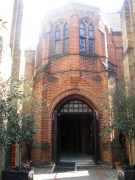
St. Mary's Bourne StreetWe arrived early to the church of St. Mary’s Bourne Street, London. Just off Sloane Square, the church goes back to the late nineteenth-century Anglo-Catholic revival, and while once a mission in a needy parish, now sits in a neighborhood of well-to-do townhouses.
The brick arched entryway leads into the nave through the north aisle like a treasured passageway or passageway of treasure, as though mystery and miracle were embedded in the stone. The walls are lovingly furnished with side altars and flowers, plaques and flaming candles. We moved to a row of chairs in back, pulled out a kneeling cushion from a hook, and knelt to pray our thanksgivings.

The Anglo-Catholics are Anglican Protestants who do (did) not want to give up the glorious worship of Catholicism, so their spaces attempt to recreate heaven with gold, marble, candlelight, incense, music, art. How does one express God-with-us? How does one express being in the presence of the Almighty? the Creator? As I gazed upon the high altar, watching a priest light the numerous candles on a lowered chandelier, I thought St. Mary’s Bourne Street did indeed remind me of heaven, and put me in the mood to worship, to meet God face-to-face. And that, in the end, was what liturgy was really all about, to meet God, to be renewed, reborn.

A friend from St. Thomas’ Church in San Francisco was there today – he had made London his home for a few years now – so it was a particularly joyous occasion for us to see him again and to worship together. But I also had been looking forward to the church’s annual May Procession of Our Lady. I had seen photos on Facebook, how they process around the neighborhood, carrying her image. For May is Mary’s month, and this was, after all, St. Mary’s Church.

Marian ProcessionThe choir was particularly joyous today, filling the vaults with their huge song. We moved through the Mass, with Scripture readings, sermon, and Eucharist. Then the procession formed at the head of the central aisle, and the congregation followed. We joined, holding our song sheets and stepping forward. Soon we were singing with the others, walking down the the left lane of the paved road, circuiting several blocks. Ave, Ave, Ave, Maria…. It was the familiar Lourdes hymn to Mary and I smiled, suddenly recalling our visit to Lourdes years ago. In Lourdes there had been thousands holding candles in the dark moving up the wide esplanade, but today, in this busy and sophisticated city, we numbered about one hundred happy souls and we held song sheets in the partial grays of a London morning.
I glanced at the townhouses lining our route. Windows and doors opened. Folks peered out. One man joined the singing from his front step, a strong baritone. Others stood on their porches, watching. We continued, this peaceful and lively stream of Christian exuberance and public witness, finally returning to the red-brick entrance of St. Mary’s. The organ boomed, the choir greeted us in the narthex as we entered, welcoming us home.

The Marian procession ended with Benediction, fittingly, and now we sang once again as a congregation in church, surrounded by the arched stone and gilded art, the billowing incense and flaming candles. Now the gilded monstrance with the Host was removed from the tabernacle and placed on the altar. I gave thanks for all of this, all of these visible and sacramental acts of worship. I gave thanks for God-with-us.

Soon we met in the adjoining house for champagne and catching up with the vicar, Father Cherry, and our friend from San Francisco, Peter. As we chatted, I thought how this trip to Rome, Paris, and London had been so richly rewarding and was now brought to such an appropriate end here at St. Mary’s in London, this Anglican city, in England, this Anglican country.

I have said many Aves and many Our Fathers and asked for guidance again and again. One never quite knows what God has in store, what his will is for that day, that hour, that minute, so being a Christian is always an adventure. But looking back over the last three weeks, I can say he has blessed us immensely and Our Lady has looked after us. He led me to Father Paolo of the Camillians in Rome who care for the Baroque church of La Maddalena, a setting for my novel soon to be released, The Magdalene Mystery. Our Lord led me to the home of the gracious and charming Nicholas Mosley and his lovely wife Verity in London. Nicholas Mosley (Lord Ravensdale) wrote The Life of Raymond Raynes, a biography our American Church Union is currently republishing, and I have the delight to edit. We shared our love for Father Raynes and his mission to each of us, enlivening our faith with his words, and his presence again among us. And this morning Our Lord led me to St. Mary’s Bourne Street, where I could see old friends and honor his blessed mother Mary.

I think, now as I write, of all the lovely Madonnas I visited in Rome and Paris. And on this cloudy gray day in London, I was thankful for all of them, and all the wonders of our journey through these moments in time.

Santa Maria del Popolo, San Silvestro in Capite, Santa Maria in Via, Roma

Santa Maria del Popolo

Santa Maria del Popolo

I have fallen into a ritual of visiting Our Lady on this trip. Rome has so many stunning Madonnas, some brought in from the street corners where they once blessed a neighborhood, some from private homes where prayers were answered miraculously. Each one is different, each pulls me with a pathos and a joy, and I sense the Holy Spirit still working through these images.

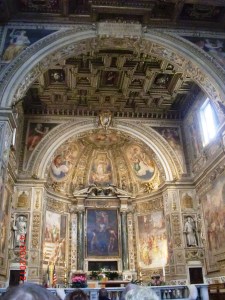
So it was natural, on our last day in Rome to revisit Santa Maria della Popolo, Saint Mary of the People, which guards one of the main gates to Rome, where the Via Flaminia ends, bringing pilgrims from the north. I recalled a striking Madonna and Child over the high altar.

The church has interesting origins. Nero’s grave, said to have been on this site, terrified the locals who saw crows in the form of demons in one of the trees.  In 1099 Pope Paschal II cut down the tree, threw Nero’s remains into the Tiber, and built a chapel. In 1472 Sixtus IV built the Renaissance church we see today, which was soon layered with Baroque, and dedicated it to St. Mary of the People. Martin Luther once stayed in the Augustinian monastery next door. We crossed the broad piazza leading to the church and entered as a Mass was ending.

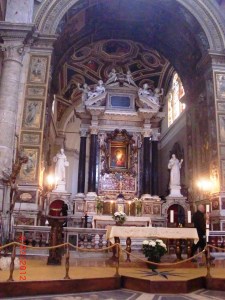
Chapels run along the side aisles, lining the nave leading to the high altar. Above the altar is the stunning Madonna. I paused and genuflected before the tabernacle – the red candle was aflame – and prayed my thanksgivings for the witness here in this church. I said my Ave Maria and she smiled upon me. We turned to the north transept chapel to see the famous Caravaggios, which appeared to have been completely restored, for the colors were unusually vibrant.

One is the famous painting of Saint Paul’s conversion. He lies on the ground, struck blind by the vision, with his horse nearby. The thrust of the light is tangible, and I am reminded of the angels appearing to the shepherds, saying, “Be not afraid.” I also recalled our priest at home mentioning in a sermon that Paul’s vision was permanently damaged, for while he regained his sight, he writes in his letters that he cannot see well. This I can appreciate, as, with age, my own sight is dimming. The second Caravaggio is the crucifixion of Saint Peter, the cross upside down to be different from his Lord’s crucifixion. The soldiers are fixing him to the cross, and I can hear Our Lord’s words to Peter earlier, that he would go where he did not want to go. Both paintings speak to us, for the figures are fully human and we are placed in the center of the drama, the suffering of these saints. And yet also, there is the drama of hope, that in these moments we are given a great legacy. So too, grace redeems our own suffering.

We next visited Santa Maria dei Miracoli, one of the twin churches on the other side of the piazza, at the head of the busy Corso. Here too a miraculous Madonna watches over the high altar, and I believe the story involved the flooding of the Tiber, as many stories do in Rome. We continued along the Corso, visiting several other Baroque churches – each unique with its own divine character stamped upon it through time.

San Silvestro in Capite

San Silvestro in Capite

We passed shops and shoppers, tourists, and crossed intersections with great care as cars and scooters whizzed by, and buses took over the road. We soon found the familiar San Silvestro in Capite, the British church in Rome. The name in capite refers to the famous relic housed in the northern side chapel off the narthex, the head of John the Baptist. The Irish Pallottini Fathers are in residence. and when we had visited a few years back, Father Fitzpatrick, the Rector, was in the process of ordering a new reliquary for the valuable relic.

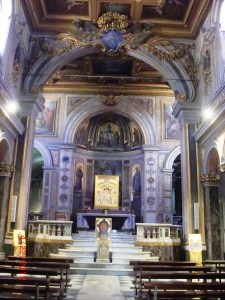
Built over Emperor Aurelian’s temple to the sun, Popes Stephen III and Paul I built the first church in the 8th century to house bones brought from the catacombs (a list of the saints  who were entombed frames the front door), and it was rebuilt in the 12th and 16th centuries. The relics of Popes Silvester, Stephen I, and Dionysus rest under the high altar. Beyond the altar the grill remains where Poor Clares, who cared for the church until 1876, could take part in services.

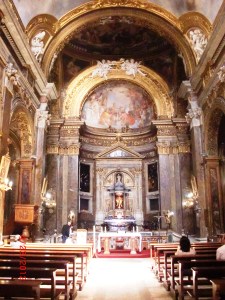
We entered the ancient courtyard where columns and plaques witness to the earlier church, then stepped into the gold and marble interior. Another Baroque jewel of Rome, this church has the sense of holiness that we all yearn for. When I enter these churches – La Maddalena, Santa Sabina, Santa Susanna, San Silvestro – I am called to pause and pray. There is a hush that seems naturally prescient, nearly tangible, urging me. Light a candle, the hush is saying. Pray for a loved one. Pray for the suffering. Pray for your will to be God’s will. Pray, pray, pray. As for myself, I often don’t have the words to pray, to say what is in my heart.  So I use words given to me by the Church – the Our Father, the Hail Mary, the Te Deum, the simple Glory Be, and I am grateful for those prayers given.

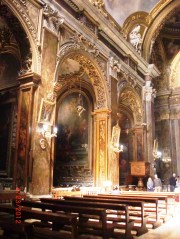
North Aisle, S.SilvestroThis day, Wednesday, the sun shafted upon the wooden pews and through the gilded arches of the side aisles, and I sighed and smiled with a sudden joy. We knelt and said a prayer, and padded silently back down the central aisle towards the front doors. We entered the side chapel to the right to visit John the Baptist’s relic, which now was indeed housed in an ornate and intricate gilded reliquary, as was fitting. Prepare ye the way of the Lord, he cried, and now we have the way, through the Church known through churches like this one.
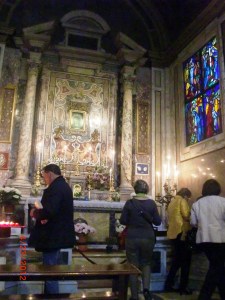
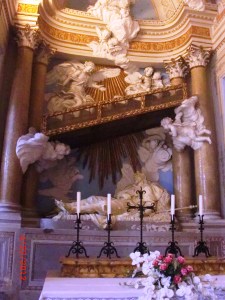
We then crossed the narthex to a small office to say hello to Father Fitzpatrick, who was fortuitously in his office. He looked up and recalled me from our earlier visit and smiled a big welcoming smile. I told him about my new novel coming out, The Magdalene Mystery, and he nodded his appreciation (he already had Pilgrimage). He seemed very busy, and I fear we interrupted him, but the few minutes he gave us were ours totally. His eyes rested on mine, full of a liveliness that only God knows. It was good to see him again.

Santa Maria del Pozzo

Santa Maria del Pozzo

We left San Silvestro to enter the new piazza formed from the former muni-bus lot, a welcome transformation, then found Santa Maria in Via on one of the busiest arteries in Rome, the Via del Tritone. Santa Maria in Via refers to the ninth-century chapel “on the way” to the Via Flaminia, that main route in and out of Rome. It seems that in the thirteenth century there was a well on the chapel property that overflowed. A picture of Mary floated on the top of the waters. She became the Madonna of the Well, Santa Maria del Pozzo, deemed miraculous. Today she blesses a southern side chapel off the narthex, a place of respite in the frenetic Corso to pause and drink from the waters and say a prayer to Our Lady, for her encouragement and direction.

It was time for lunch, time to reflect on our time in this miraculous, eternal city, and to pray that one day we would return to revisit her saints and shrines, her churches and chapels.

The Aventino, Isola Tiberina, Roma

Santa Sabina, Roma

Santa Sabina, Roma

It’s been chilly with intermittent rain but Tuesday morning the sun seemed promising, appearing suddenly from behind cumulus clouds that floated through the skies. We headed for the Aventino, a leafy district of Imperial Rome that looks over the river from its hilltop, today home to ancient house churches, basilicas, monasteries, and quiet cypress-lined lanes.

First we visited fifth-century Santa Sabina, built over a house church, the mansion belonging to the matron Sabina in the fourth century. The church retains its ancient basilica style, open and long, with the choir enclosed at the head of the nave. Often when we have visited in the past chairs filled the space, but this morning the nave was empty. We stepped slowly over the marble floors to the enclosed choir, then along the side aisles lined with giant fluted columns. Time seems to collapse here, where the high clerestory windows allow angled and limited light, and draw the eye upwards. Earlier, outside, we had heard children playing in a school yard, their shouts mingling to form an exuberant and raucous chorus across the street, but inside now all was silent. The quiet padding of my shoes was the only sound that broke the silence. I recalled fondly the scenes set here in my first novel, Pilgrimage, and visiting Santa Sabina was like visiting an old friend. The Dominicans are in residence here, and it was here that St. Dominic met St. Francis. They have an excellent gift shop in the adjacent building with icons and medals and candles for sale.

We continued to neighboring fifth-century San Alessio and peered at the image of

San Alessio, Roma

San Alessio

Alessio under the stairs, in the north aisle near the entrance. Tradition says that Alessio was the son of a wealthy family in the Aventino. He left his home to become a humble beggar, traveling as far as Edessa, Turkey. When he returned, no one recognized him, and he lived under an outside staircase. When he died, his parents found his story on a paper clasped in his hand. The story touches me, for it is about exile, humility, family, and with today’s broken families, broken by geography as well as belief, it was a familiar one.

We walked up the side aisle. The back garden was open, and from its terrace you can see St. Peter’s across the river, far beyond the red roofs of Rome. The crypt was open as well, and we descended irregular steps to the dim tenth-century sanctuary, haunting with frescoed figures on the walls peering at us intruders. Relics of Saint Thomas Becket sanctify the altar, aligned under the high altar above. Returning to the nave, I prayed an Angelus before the beautiful Madonna of Edessa, her icon blessing the north aisle.

We walked on to San Anselmo, a Benedictine monastery (they sing Gregorian chant 9 a.m. Sundays), but only had a moment to look into the spotless and shiny marbled interior, then bought some Trappist chocolate in the adjacent shop. The shop is also well stocked with icons, honey, olive oil, and other products made by the Trappists in Rome.

We were watching the time, for most churches close at noon for a few hours, and it was getting close to noon. We headed back to the path adjacent to Santa Sabina’s orange garden (the garden has wonderful views of Rome as well) and followed the cobblestones down to the river. We crossed the busy intersection (the Boca della Veritas is nearby), and walked along the river up toward Isola Tiberina and San Bartolomeo.

Isola Tiberina from the river path

Isola Tiberina from the river path

It’s a lovely walk when the sun is out, the light filtering through the arcade of poplars that line the river path. The river was high this year – they’ve had lots of rain – and peering over the embankment, the greenish waters were rising over the lower walkway. Soon we came to the old footbridge that led to this charming island in the center of the Tiber.

Isola Tiberina houses a hospital, a restaurant, perhaps a hotel (?), and the ancient church of San Bartolomeo, now cared for by the Community of San Egidio, a new evangelical Catholic group dedicated to the poor.

We arrived in time (now after noon), for the church was still open. We entered

San Bartolomeo, Interior

San Bartolomeo, Interior

and paused at the foot of the central aisle. A dark ark, a boat-like reliquary, houses the relics of Saint Bartholomew, the Apostle, thought to be the same as Nathaniel. The ark has been turned into an altar, and it sits in its humble earthiness in the chancel, with several icons surrounding it. We stepped up the the altar and genuflected, then turned to the right to the south transept chapel to visit a stunning Madonna and Child. I said another Angelus, thinking a host of Madonnas were now praying for me. I find it so touching that there are so many different Madonnas in Catholicism, so that she may reach many nations and many individuals with unique desires and sufferings.

As we crossed the Pont Fabriccio back to the mainland, and as we stepped along the dappled path bordering the river, we thought it was just about time for lunch. It had been a good morning, a morning of sun and old stone and pondering the past made present by these amazing churches.

Santa Susanna, Roma

Santa Susanna, Roma

Santa Susanna, Roma

We arrived early to the 10:30 Sunday Mass at Santa Susanna and climbed the steps to the parish library.

My protagonists Kelly and Daniel in The Magdalene Mystery, begin their quest here in the library of Santa Susanna. It is here that they learn what must be achieved to receive a great legacy, here they receive the first clue. The rooms lined with books in English were as I recalled from earlier visits, and we searched for my trilogy of novels in the books – Pilgrimage, Offerings, and Inheritance – and sure enough, there they were in the Fiction section. I didn’t see Hana-lani – perhaps it was checked out.

Sister Nancy sat behind the desk and greeted us. I told her about The Magdalene Mystery soon to be available, partially set at Santa Susanna, and she and two other women (also sisters, I believe) were enthusiastic. I explained I wanted to correct the lies in Dan Brown’s stories, particularly about Mary Magdalene, and they nodded with vociferous agreement. As members of the American Catholic church in Rome, located across the street from a setting of Angels and Demons, the folks of Santa Susanna knew all about Brown’s mistakes, about his lack of respect for Christianity.

We excused ourselves for Mass downstairs. As we entered I thought how on this site stood the home of the saint and her place of martyrdom. Here she was beheaded by Emperor Diocletian’s soldiers in 293 for refusing to renounce her beliefs and for refusing to marry Diocletian’s general. Her family was Christian, her father a priest, and her uncle Caius was Bishop of Rome (280-296). Other members of her family were martyred; Bishop Caius escaped, to live another three  years.

As we found seats I gazed at the stories covering the walls, the stories of both the Roman Susanna and the Old Testament Susanna. The pinks and peach tones, the soft wash of light and color in such balanced and welcoming space gives a tranquil cast to the interior. When I enter this church, like many in Rome, I feel as though I have left the noise and fumes and secularism of the busy city outside and stepped inside to heaven.

Looking about me at the glorious interior of art and color, I did indeed fall into another world. The choir, sitting in the south transept was practicing, and their voices echoed through the vaults. The raised chancel was flowered with Easter lilies, and the white Eucharistic table waited, in the modern manner, creating a more central altar, pulled away from the apsidal wall. A grated window could be seen in that wall, where once nuns could be silently present at the Mass. The Paschal candle burned brightly. The nave soon filled with faithful Americans in Rome, and clergy followed acolytes bearing crucifix and flaming candles, processing up the central aisle. We helped them with our singing, Love divine, all loves excelling…. and I noticed that the regular clergy of Santa Susanna were not among them this day, but rather Paulists were here on pilgrimage, some in the procession, some in the congregation. Father Paul Robichaud, former Rector of Santa Susanna and currently Postulator for the Cause of Father Isaac Thomas Hecker, celebrated and preached. He preached on the Good Shepherd, how Jesus is the only way to heaven. He knows us and we know him. He said that in order to understand the importance of this we must admit that life is hard, that suffering exists, and I would add, that death exists. Only when we admit we live in a fallen world, that we ourselves are fallen creatures, can we see why we need God. This admission is largely not made today, and God is not sought after. But the truth is that we are indeed broken and desire mending. Simple and profound, I thought. And so true.

We left Santa Susanna, full of God, his glory, his presence, his weaving through history and his people. Through song, prayer, sacrament, and word, we continued the great Incarnation into today, re-membering, thankful.

(www.santasusanna.org)

Santa Maddalena and the Camillians, Roma

La Maddalena, Roma

La Maddalena, Roma

My husband and I have returned to Rome for a few days to explore her many mysteries once again, and I wondered what I would discover on this trip, where I would be led, what adventure would unfold.

My novel, The Magdalene Mystery, to be released in May through OakTara Publishers, is set in Rome and Provence. Five of Rome’s extraordinary churches provide settings for the first half of the novel, and I wanted to see these churches again before signing off on the final proofs of the manuscript.

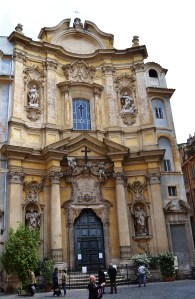
We found Santa Maria Maddalena on Saturday, using the route my protagonists take (to verify accuracy). We climbed the few steps to the simple doors set in the creamy Baroque façade and entered. As always when I enter La Maddalena, I took a sharp breath, for the beauty is tangible, the golds and marbles in such a small space filling my senses. I walked slowly up the central aisle, and halfway up, paused before the sweet icon of Our Lady of Health in the south aisle. I slipped a coin in to an iron box, reached for a votive candle and lit the wick with one already aflame, then set it carefully on the blackened tray. I said the Angelus, prayed for Our Lady’s prayers for my little novel set in this charming church. I then returned to the aisle and resumed my way to the high altar where a red candle burned. I genuflected, turned and saw the southern transept chapel was roped off. This was the Crucifix Chapel, where the scenes in this church are set. I looked around and saw a worker in a blue smock who was cleaning in the north aisle. We followed him into the ornate sacristy.

I asked the young man if he spoke English. Yes, he did, a little. I asked if he could give me the name of the priest-in-charge, so that I could send him a copy of my novel once available. Could he give me a name and address?

Ah, he said smiling, you would like a book about the church?

No, I said, I have written a book with the church in it. I want to give the church a book. As a thank you. (A huge thank you, I thought.)

He looked confused (which seems reasonable now on reflection) but raised his finger and moved toward the phone desk, where the resident clergy were listed on a laminated sheet. He picked up the phone, we waited, and after a minute, he hung up. Ah, he said, no one is home.

I was ready to give up the idea, but he raised his finger again and said, wait here. I go and find him. I think I hear him coming now.

We waited, wondering, and spent our time looking at the fantastic woodwork and paintings in this historic sacristy. Soon a slim dapper man in sweater and slacks approached us and shook our hands with ingenuous warmth. He was Father Paolo, and he was a Camillian, a brother of the Order of St. Camillus. The Camillians, Servants of the Sick, had been in charge of the church since it was built in the seventeenth century, shortly after Saint Camillus died in 1614, and before that in charge of the little oratory on the site. Father Paul didn’t wear the black cassock with the recognizable red cross on the front that identifies the Camillian Servants of the Sick, a red cross that was a forerunner of the Red Cross organization we all know today.

Father Paul spoke excellent English. He soon understood that my novel was set right here in his church.

He smiled. I will give you a tour, he said. You should have a privato tour. It is a big year for the Camillians. We will be celebrating our 400th anniversary! We are building a museum upstairs. It is not finished, but you can see.

Thus began a remarkable hour with Father Paolo who was incredibly gracious with his time and attention. He told us the story of their saint – the dissolute young Camillus de Lellis, converted after being wounded in war, after suffering for many years in Rome hospitals bleeding wounds that would not heal. He studied to become a priest, to help the sick throughout Rome, to comfort the dying, to nurse those with the plague. He gathered others around him who dedicated themselves to God to serve as he did, and the Pope gave them the small oratory near the Tiber dedicated to Mary Magdalene.

Ah, I said, yes, Mary Magdalene.

He nodded. Do you know the story of how the chapel came to be? No, I said. The Tiber flooded, he said, and the people found a wooden statue of the saint on the banks. It survived the flood, you see. They knew it was an image of Mary Magdalene because of the ointment jar she held. It is downstairs in the chapel.

I grinned. So that is how it got there, I thought. Another piece of the mysterious puzzle of Rome.

We were given a tour of the museum in progress – we passed workers upstairs with scaffolds and peered into the saint’s rooms. We saw relics and read histories, even how the wax mask was made of the face. And we returned downstairs where Father Paul led us in to the Chapel of the Crucifix.

I gazed upon the corpus on the cross. Like the crucifix in San Damiano that spoke to St. Francis outside of Assisi, Christ spoke to Camillus de Lellis when he was gathering his first helpers. At the time Camillus was discouraged. Was this really the work that he was supposed to be doing for God? Then he heard Christ say to him, “Keep going, for I will be with you and will help you. This is my work and not yours!”

I loved those words. They spoke to me as well. And as I gazed into the eyes of this joyful brother of St. Camillus, I knew they spoke to him. And I was grateful for this moment of friendship and communion.

So my little novel will be released in May, shortly before the great 400th year celebration of the Camillians, which as I understand, begins in July 2013 and lasts through July 2014, commemorating Camillus’s death July 14, 1614. I have not had a chance to read the thick glossy book our host gave us that is a part of the new celebration, but on glancing through it I can see that today the Camillian family of brothers and lay orders are worldwide, serving the sick and the suffering. They comfort and heal, build, and nurture.

They are bringing the love of Christ to the world’s people, and the people to Christ.

I was glad it was a good year for my novel to be born. As I said goodbye to the simple carving of Santa Maria Maddalena in the Crucifix Chapel and to the Madonna of Health glimmering in the south aisle, I was grateful. We said goodbye to Father Paolo. He gave us his blessing, and we stepped slowly down the aisle to the simple entrance, glancing up to the gilded choir loft with its golden cherubs and saints.

Our first day in Rome was indeed full of mystery and miracle.

Thanks be to God.

A Grotto of Light

This week I received the cover copy for my new novel, The Magdalene Mystery. This is an awe-inspiring moment in the process of publishing, for this is the image that my potential readers will see first. This cover will draw them in, or perhaps turn them away.

This part of the process is a simple one for me. I submit possible images to the OakTara’s design team, usually my own photos, and the designers then work their magic. With each book, I wonder, what will the cover look like?

This cover stunned me. Minute images of Mary Magdalene’s  grotto in the Provencal mountains – barely seen in my photo – were pulled out and enlarged, and with nuanced lighting, an aura of deep mystery was created. It was a remarkable transformation, and I for one, was drawn in by the effect.

How we see our world, how we know truth, is a major theme of the novel. The mystery of the grotto and the mystery of the saint herself have haunted both scholars and ordinary folks for centuries. What really happened two thousand years ago on the hill of the skull outside the great city of Jerusalem? In the burial garden was the stone miraculously rolled away? Did Mary Magdalene see the risen Christ? How can we know?

We peer into history just as we peer into this novel cover, where darkness meets light, and the light shines in the darkness. We look at the author’s name and evaluate her reliability as a chronicler of truth. Can we trust her? Can we believe her stories or the truths that lie beneath the stories?

I am currently reading a very good novel about (among other things) the nature of art, titled The Third Grace, by Deb Elkink, that I shall be reviewing soon. The author states at one point that, just as you are what you eat, you are what you read. I believe this to be profoundly true, and something not taken seriously enough today. There is a subtle working on the mind that occurs in reading anything, but even more so in reading a work that has layers of meaning, complex characters, and human relationships that exhibit truths about our world, about ourselves, about our humanity, like any work of art. We enter the author’s created universe and are largely in his or her hands to be molded into something else. We must trust the author.

Today’s world is one of little moral restraint or judgment, and this is true also of novel-writing. There are many authors who write to titillate the senses, not elevate them, to appeal to the reader’s dark places and not their better parts. Gratuitous sex and violence, often paired, are expected, and since addictive, often demanded. Slimly veiled pornography becomes the latest bestseller. So we must trust the author (and the reviewer) and perhaps not put too much trust in the media rankings.

As human beings we are constantly changing. There is no pausing for us, no halting. We either move forward or backward; we either grow or shrink. As we read lines on a page, we feed our souls and minds and hearts with a kind of food. Is it fatty? Is it tasty? Is it addictive? Does it enlighten or darken our sensibilities? Is it good for us or is it candy-coated poison refashioning our thought processes, our desires, our view of the world? Is it pure propaganda?

There is a just and proper place for showing the darkness of man, for revealing evil. But is the darkness, in the end, redeemed by the light?

Today was Good Shepherd Sunday, and I never tire of hearing the assigned Gospel, John 10:11+, where Christ says he is the good shepherd who gives his life for his sheep. The sheep know his voice; they belong to him. He knows them; they know him. In another passage he says he is the only way, the only door, to heaven. How do we, his sheep, know him? How do we know this door, know the path to take, know his voice? We learn to know him through Scripture, sacrament, and prayer. It is a lifelong growing process, this learning to know the shepherd of our souls.

As I gaze upon Mary Magdalene’s grotto deep in the center of my book cover, I realize that the darkness that enshrouds the cavern chapel in those Provencal mountains may be encroaching, but is not final. The grotto is lit with light, a light shining in the darkness. Just so, I pray that my own little story inside that cover will enlighten a few hearts, minds, souls, that it will feed a few sheep with the truth of the good shepherd, that it will lead us all closer along the path to his door, and he will know us just as we can indeed know him.