Thanksgiving for Hana

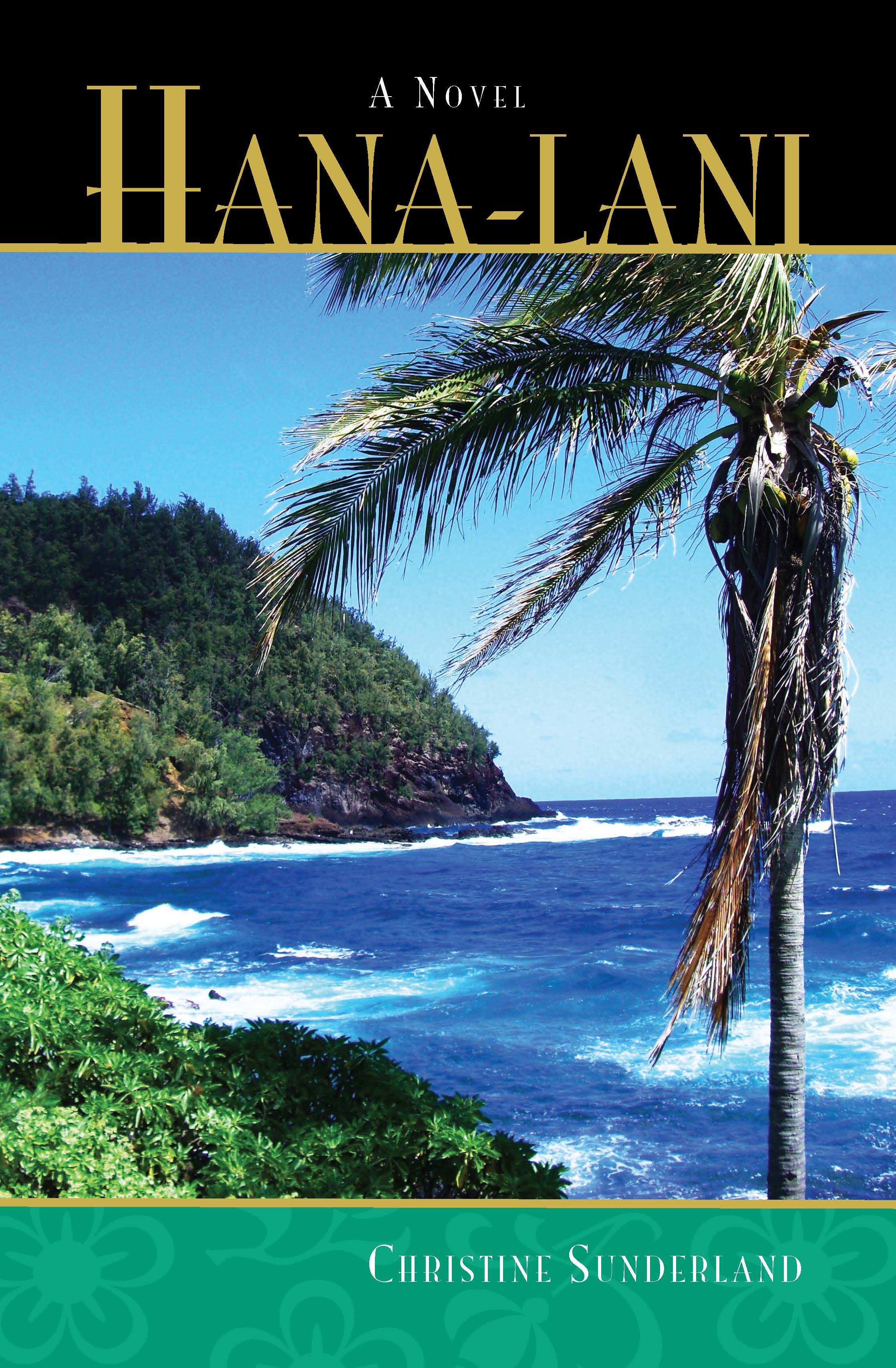
HANA-LANIThis Thanksgiving weekend we spent giving thanks for Hana, Maui. We arrived in the dusk of Tuesday evening, flying low along the coast from Kahului to Hana. Darkness was descending quickly and a thick fog enshrouded our small nine-seater plane. I knew that Hana Airport had no radar, and if we could not land due to poor visibility we would turn around and return to Kahului Airport, where we would need to rent a car for the two hour winding trip to Hana.

Suspended in the fog, it seemed we were floating. I began to pray. Then I sensed the plane had curved out to sea searching for visibility pockets, but it was actually making a different approach, coming in from the south. Soon we saw the coastline of land and sea, the gentle green shape of Ka’uiki Head reaching out from Hana Bay, with its lighthouse alight and welcoming, and soon we heard the wheels touch the landing strip. We rolled between the lights flaring along the sides of the runway. Safe. With bowed heads we maneuvered through the exit door and climbed down the rope ladder to terra firma.

The pilot explained he used GPS (I suppose I should not have worried) but when he said that he missed the “twilight cutoff” by one minute I asked what he meant. “I’m not allowed to land at the Hana Airport after twilight.” “Oh,” I said. One minute? My prayers were needed after all.

The temps have been on the cool side even for this rain forest on the eastern shore of Maui in the middle of winter, but in spite of winds and gray skies, rain has been mostly at night and we have been able to walk a bit. But the loveliness of Hana isn’t just the tropical temperatures, the palms, the roaring surf, the little drinks with umbrellas, but rather the people. Over the years we have come to appreciate this village that nestles under the volcano Haleakala, that is protected by Fagan’s Cross standing like a beacon on one of the green foothills.

And so I wrote Hana-lani, a love story set here, and in the dreaming and the courtship of words and phrases and sentences, as I married language that reflected the many colors, sounds, and fragrances, with the family and faith of Hana, I’ve been blessed by the warm hospitality of the folks that live here. We return to Hana, it is true, to rest, relax, and listen to the surf (and sip a few Mai Tais) but also to enjoy the people.

We are in our gentle years and not quite as active as we once were, but the paths that meander over the lawns of our hotel are kind and beckoning, with views of the sea and the spewing white foam. And from our veranda we can see Ka’uiki Head, the same scene that’s on the cover of my novel. At night, surf pounds and rain rattles the roof. In the day, we read and rest, and I create my next scene in The Fire Trail. And all the while, I say my prayers of thanksgiving as we slip into Advent and the marking of a new Church Year.

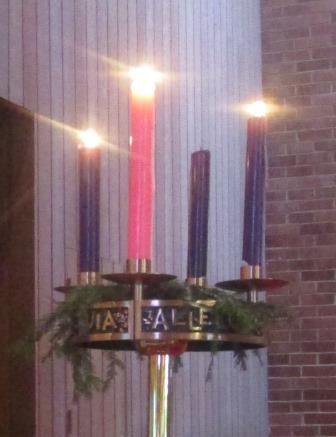
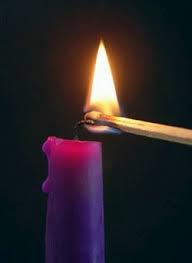
St. Mary's Hana compOur time in Hana has been appropriately bracketed by Eucharists celebrated on Thanksgiving and today, Advent I. We climbed the white stairs to St. Mary’s and entered through an arched portal into the airy space where prayers mingle with breezes wafting through open windows. It is a white church, set on a green hillside, Fagan’s Cross higher up, and the volcano behind that, and today the chancel was splashed with purple hangings for Advent. Four Advent candles nested in their greens and the Lady altar had been lovingly decorated with flowers (we joined in a Rosary before Mass). The polished wooden pews have comfortable kneelers, and for this I am grateful, because I like to kneel when I pray.
They say that gratitude is a good cure for depression (and drug-free), forcing one to turn outward and less inward, becoming a bit more selfless and a little less self-centered. I think there is truth in this, and it is also true that it is a good preparation for penitence, a cleaning out of the heart. For when I am thankful for the blessings of each day, beginning with the blessing of waking to the day itself, I am humbled. And in the humbling I see places in my heart that need cleaning out… dark corners where envy, pride, idolatry, sloth, gluttony, wrath, and all their many many relatives, have hidden. It is good to give my soul a good sweeping, to let the fresh air in, just as the breezes blow through the windows of St. Mary’s.

In this holy season I will re-learn the Advent collect in the Book of Common Prayer

ALMIGHTY God, give us grace that we may cast away the works of darkness, and put upon us the armour of light, now in the time of this mortal life, in which thy Son Jesus Christ came to visit us in great humility; that in the last day, when he shall come again in his glorious majesty to judge both the quick and the dead, we may rise to the life immortal, through him who liveth and reigneth with thee and the Holy Ghost, now and ever. Amen.

I will re-memorize these words and place them in my newly swept heart. I shall hold them close, so that I may retrieve them at any moment in any place during this holy season. They are words that sum up our hopeful faith and faithful hope, these sixteenth-century phrases of Bishop Cranmer. I would like to have that armor of light. I would like to rise to that life immortal. 

Advent St. JSo we trundled up the stairs to St. Mary’s and worshiped God with the lovely people of Hana. Many ages formed the congregation, and while I was pleased to see so many children, I was equally pleased to see the respect paid to the elderly. No one was left out, and we visitors were greeted with vine leis, a sweet kindness.

Sometimes we sang together in Hawaiian, sometimes in English, as we accomplished the “work of the people,” the Holy Liturgy, joining together in the great action of the Mass, with Scripture, sermon, creed, confession, consecration of the bread and wine, communion. In this huge prayer we took part in a drama enacted throughout the world and throughout time, and we sang with the angels and saints in Heaven. I think God was pleased with the offering of his children in Hana. 

We have entered Advent, the season of the coming of Christ Jesus among us, humbly as a child who donned our flesh and shared our sufferings, so that he could unite with us and carry us to Heaven. We now look to Christ’s coming again, his second advent, in glory to judge the living and the dead. Will we be ready? We are told it could happen now, tomorrow, the next day. So we practice penitence, as we wait for that glorious advent; we cast away the works of darkness and put upon us the armor of light.

Giving Thanks

prayerToday is the last Sunday of the Church Year and the Sunday before our national Day of Thanksgiving. Thanksgiving is the best antidote to selfishness and the best prescription for selflessness and thus leads naturally to the First Sunday in Advent.

Melanie McDonagh in the November 1 issue of The British Spectator makes the profound observation that the “cult of mindfulness” is largely a cult of self. It may or may not bring peace, alleviate stress, even heal depression, but it is an isolated lonely cult in which the focus is on one’s inner self. She is correct that the idea of living in the moment is pure Buddhism, and like Buddhism, the idea encourages us to escape suffering rather than face it, wrestle with it, and create meaning from it.

I have found that Christianity and Judaism pull the believer out of himself. It is through being self-less not self-ish that we find peace, and indeed, it is an inner peace that we find. How does this strange contradiction work? It works because in prayer we are focusing on the God who made us, and yet who also lives within us. Without belief in this objectively real God, we are merely wallowing in our own selves. Christianity brings the believer into community with all sorts of folks unlike him or her, different in age, gender, race, class, interests. We rub shoulders, we share tea, we are solicitous of one another. Most of all, we worship God (not ourselves) together, sharing this common outward vision, as we act out and re-present the great liturgical drama of church or temple.

And so Christianity and Judaism urge the believer to look around and, yes, smell the roses and live in the minute, for every minute is a precious gift. But these religions do far more. They urge the believer to face and interact with the real world. We call this interaction love, brotherly love. It is the sacrifice of that precious minute given by God, for the minutes are numbered, in order to give that minute to another, a stranger, someone unlike us. We pray for others; we visit the sick, shut-in, and lonely; we support charities that support life in all its facets, joyful and sorrowful. The history of the West is the history of this urge to better our world, to care for our communities.

Within this urge, this still small voice directing us to love, lies judgment. Judgment is not popular today; we are told we must not point fingers. And yet if we do not see clearly the true nature of what is happening around us and within us, we cannot better the world, and we cannot better ourselves.

God has spoken to his creation through his chosen people over many centuries. He has clearly marked the path to glory. The path takes us outside of ourselves so that God can enter those same selves. By shedding “me,” I miraculously find “me.”

One of the ways God has shown us how to do this is through simple thankfulness. The psalms are full of thanksgiving to God. To pray the psalms is to leave no room for depression. To offer oneself up is to know joy. It’s as simple as that. The Lord’s Prayer opens with praise that pulls us heavenward: Our Father, hallowed be thy name, thy kingdom come… Thanksgiving lives inside every word of praise.

And so this Thanksgiving Day, I look around me at my world, my nation, my community, my own heart. I try to see honestly, and I see generations of children raised in the cult of mindfulness. I see them highly mindful of their self-esteem, prone to take offense, demanding and self-righteous. They have lost themselves in themselves, as though whirling downwards, pulled into a vortex where depression imprisons them.

But on this Sunday before Advent and before Thanksgiving, I also look around me and see churches and temples where true thanksgiving is offered to a very real and loving Creator. I see voices raised together, not always in tune, singing thanksgiving and praise. I see love weaving among these communities of true believers who thank, not the stars, but the living and Almighty God for their very breath. I see islands of faith that show us how to be free from ourselves, not enslaved by ourselves. We do this by giving thanks to God for life, liberty, and the pursuit of happiness.

Today is called in our Anglican tradition “Stir-up Sunday,” named after Thomas Cranmer’s powerful Collect, the collecting or gathering prayer for this day, written in the sixteenth century:

“Stir up, we beseech thee, O Lord, the wills of thy faithful people; that they, plenteously bringing forth the fruit of good works, may by thee be plenteously rewarded; through Jesus Christ our Lord. Amen.”

This is one of the many prayers that have formed the Western tradition. In this prayer we are called to act, to care for those around us, and through the caring itself we are interiorly rewarded. We will be changed.

And so, we look to the season of Advent, the four weeks that proclaim the advent of God becoming man, the Incarnation, the Christ child born in a stable. How do we prepare ourselves for this great coming? We give thanks, and in the giving thanks we receive God, we know joy. It is his chosen path. The way is clear.

Good Fences Make Good Neighbors

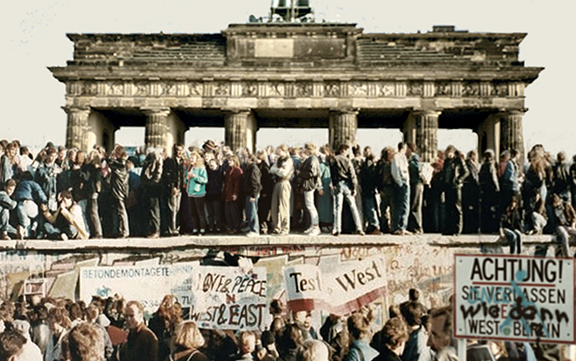
u.s.mapLast week we celebrated the twenty-fifth anniversary of the fall of the Berlin Wall. This week we worry about building a wall along our southern border high enough and in time enough to stop the flood of illegal immigrants. And we worry about a president who disregards our laws.

Walls wall people out, and they wall people in. The Berlin Wall, a part of the “iron curtain” separating the Communist East from the free West, walled people in, imprisoning them. The purpose of the border is key. The quality of freedom and the degree of tyranny on either side is key.

America, as a free society, allows freedom of travel, albeit with the legal documents to do so, documents that protect not only the traveler, but the citizenry at home and abroad. We cross borders and checkpoints, and walls seem to disappear for legal American citizens. Those of us fortunate enough to be born here must never take this for granted. Those of us who have come here legally will, to be sure, never take it for granted. Those who crossed our borders illegally however have harmed both themselves and us, for the rule of law, our justice system, is integral to America’s very definition. Illegals would not be coming to America if it were otherwise. But their breaking of our law has also harmed those legal immigrants who have waited in line patiently. Their breaking of our law has harmed the millions of law-abiding workers whose wages are challenged by an influx of a low-cost and illegal labor force.

I have found in my sixty-seven years on this earth, that personal walls are useful parameters in my life. We call such walls self-discipline. I build walls around my time, boxing in an hour to write this blog post on a Sunday afternoon, imprisoning an occasional day to write a another scene in The Fire Trail, my novel-in-progress, or fencing in a morning to worship God in church.

I don’t always feel like going to church. I confess there are often other things I would rather be doing. But my time wall tells me it’s time, it’s Sunday, and since this wall is one of the Ten Commandments, I had better have a good reason for breaking this commandment. I don’t always feel like writing this blog, but see it as a good discipline, an exercise in words, rather like my stretching exercises each morning. Who wants to exercise? We do it because we know we will feel better, that we will prevent injury by strengthening muscles and pumping the heart. If we ignore this time wall, we hurt ourselves.

Likewise, when I skip Sunday worship I don’t feel as happy as when I honor the Sabbath. A friend once said to me that there are no mentions of happiness in the Bible. I wondered about that. It turns out that each time the word blessed is used, it can be translated as happy. The difference seems to be that blessed means that the happiness is a gift from God, rather than happiness self-induced through drugs or a good dinner or any of the short-term highs we laud today.

So building that wall around Sunday morning, i.e. reserving that time for worship of God with his people, the Body of Christ, makes me blessedly happy all week. I’ve also found that morning prayers bless each day, and evening prayers bless me with a good sleep. I often tell insomniacs to try reciting the psalms… the rhythm, the worship, the letting go of oneself in the pool of God’s love is very relaxing. The best way to sleep is to let go of your self.

When I ignore those daily and weekly boundaries of time, I find a curious unease settling around my heart, as though I have starved my spirit. Studies have recently shown that church-goers are less likely to be depressed. How true.

Since the sixties, our culture has torn down boundaries and mocked moral discipline, has destroyed all kinds of walls. Deviancy has been defined down; crime has risen. Standards of dress, behavior, academics, work, and many other areas of social interaction have sought to be inclusive so that no one be offended by beauty, truth, goodness, excellence or wealth. Our culture has mainstreamed variation, including everyone in one main stream. When this happens, when walls no longer define excellence, when borders no longer define truth, goodness, and beauty, their edges smudge and we find ourselves living in a tepid gray area along with everyone else… wearing the uniform of sexless comrades in a steely city, a dystopia growing more familiar each day.

It is as though we have mistaken inclusivity and warm-heartedness for love. But God’s love, true love, loves the uniqueness of each created being, warts and all. He sees into the dark corners of our hearts; he wants to teach us how to love as he has loved and will always love; he wants us to clean out those dark places and let his light in. And so he arranged for each one of us to be created through an act of love, a union of two unique persons, complementary in gender and unique in genes, and thus we are wondrously born to be only ourselves. We can be no other. Love rejoices in these differences, doesn’t deny and merge them, hoping they will disappear in a gray land without borders.

And as we rejoice in our human differences, whether they be race, gender, beauty, or talent, let us also rejoice in the borders defining our nation, a land that is just and free, boundaries that celebrate legal crossings and prosecute illegal ones. This is the America that immigrants desire. This is the America we are proud of. This is the America we are honored to fight for in a world of shadows and merging grays.

In Robert Frost’s poem “Mending Wall,” the narrator repairs a common-border wall with his neighbor, who states, “Good fences make good neighbors.” The poet considers what this means, asking,

Why do they make good neighbors…
Before I built a wall I’d ask to know
What I was walling in or walling out
And to whom I was like to give offense.

His neighbor doesn’t consider why, just repeats his slogan. But Mr. Frost is right, it is good to answer where and why we build walls, consider who’s outside and who’s inside and possible offenses caused by our defenses, for there are good reasons.

Let us build a just wall along the borders of our nation that will  no longer invite illegal entry. Let us encourage those already here illegally to become legal through due process and to stand in line like everyone else. And let us keep the wall repaired to protect us all. Let us be good neighbors.

Tearing Down the Walls

fallofberlinwall_bundle_576x361Today is the twenty-fifth anniversary of the fall of the Berlin Wall. Today is also two days before Remembrance Day, which recalls the signing of the World War I armistice, and Veterans Day, honoring all military men and women who have served our country.

Remembering these soldiers and these wars, recalling our defense of freedom and defeat of tyranny reminds us of the fragility of peace. Evil flies in planes across our borders, bombing our cities. It creeps through the jungle into our civilized world. But it is also deep within each of us, lying dormant, or not so dormant, asleep or not so asleep. A wall runs through each heart, a wall not so unlike the one that divided Berlin. On one side, the bestial; on the other, the celestial. One side is self-preserving and tyrannical; the other is self-sacrificing and honorable. Most of us do not see the border, for we are used to it and the territories merge. It is a smudged line at best, and we ignore it.

Similar blurry lines run through cultures. Parts are barbaric and others civil. One side recognizes the law of the jungle, might makes right; the other upholds the law God gave to man, life is precious, love one another, the common good is good. In some countries the boundary is clear, a geographical periphery bordering the nation, defined by democratic institutions. In some communities it is hazy and lazy, as law-abiding neighborhoods slip into law-breaking ones. Inner cities, once “gentrified,” blur into crime-ridden communities, where politically correct policies encourage the criminals.

Other lines are more clear. We can see clearly the border between the Trade Center Towers and the terrorists who destroyed them. We see the border between the peaceful shoppers in a mall and the terrorist who beheaded the coworker. We can see also the border between the innocent runners in a marathon and the terrorists who maimed them.

We fought two World Wars so that free peoples could live freely and peacefully. How ironic and tragic that we must go to war to ensure peace. It seems to be the way of man, that one side of his heart must triumph over the other in order to protect the good from the evil. The free must triumph over those who seek to enslave them. This is a just war.

The Berlin wall was hugely symbolic and terribly effective. Many lives were lost in attempts to flee Eastern Germany and the shackles of the Communist Soviet Union, to the safety of the West. But even with the wall finally down, and even with our rejoicing in its fall, we know there are still five countries imprisoned by Communism. For them the wall has not fallen; they do not remember victory on this day or any day; they mourn for the daily victims.

Hong Kong, back under Communist China’s control since 1997, recently witnessed thousands of protesters demanding the right to vote in honest elections. The protest was quelled by tear gas, pepper spray, beatings, jailings, in an echo of the Tienanmen Square massacre twenty-five years ago. In Laos, the Lao People’s Revolutionary Party, the only party allowed, denies free speech, religious freedom, and property ownership. Like its neighbor Communist Vietnam, the government tortures and imprisons those who disagree. Cuba follows the Communist playbook as well, keeping a tight grip on thought, speech, and freedom. The border between Communist North Korea and Democratic South Korea is a clear geographical boundary, a four-hundred-mile demilitarized zone, separating a people with common language and history. The Communist North tortures and starves its citizens, denies freedom of religion, thought, travel. As Mr. Marion Smith, Executive Director of the Victims of Communism Memorial Foundation, wrote recently in the Wall Street Journal:

“To tear down that wall will require the same moral clarity that brought down the concrete and barbed-wire barrier that divided Berlin 25 years ago. The Cold War may be over, but the battle on behalf of human freedom is still being waged every day. The triumph of liberty we celebrate on this anniversary of the Berlin Wall’s destruction must not be allowed to turn to complacency in the 21st century.”

And so remembrance inspires us to rededicate and re-shore our beliefs, our courage, and yes, our military strength as a free nation in a world of shackled peoples. Recent midterm elections recognized this. I hope we will see more clearly the wall dividing freedom and tyranny, so that we may preserve our own scattered communities of peace.

And we give humble thanks to the brave men and women who have kept us free, fighting and dying for our freedoms. Thank you, thank you, thank you!

Singing with Saints

SAINTS2I’m afraid I don’t appreciate falling back an hour so that we can spring forward later in order to move an hour of light from evening to morning. It confuses the body’s natural clock, and I’ve yet to find a good reason to practice daylight saving time today. I’m told it has to do with farmers needing earlier morning light, but the advantage only lasts a few weeks.

And yet, just as when I travel across time zones, the change brings to mind the strangeness of time itself, its movement, its speed usually governed by my own attention. Time speeds up when I am thinking; it slows down when I am not focused. But we all know this is an illusion, a fact that makes the whole process even more strange.

Aging speeds time too. We live a certain life-time, a set span as though we inhabit parentheses or brackets or quotation marks. Perhaps birth is a capital letter and death the period; we are the sentence and we hope we have many clauses and interesting verbs and fascinating, colorful nouns. One way or another we travel a road through time from birth to death, like flipping pages in a book, and the traveling seems to speed up as we move along. Those childhood years stretched out, especially those summer months with no school (at least in my childhood) and those long lazy days of reading and riding bikes into dusk and darkness and someone called you in.

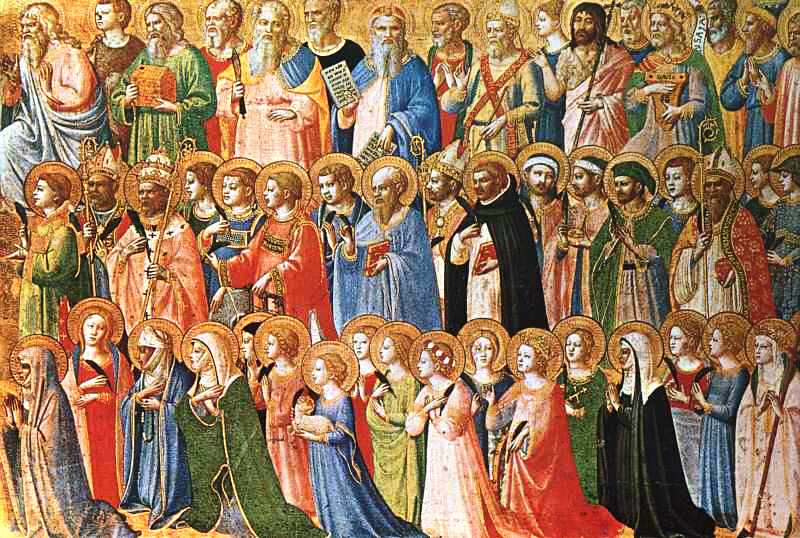
And so it seemed appropriate that the Festival of All Saints landed this weekend, All Saints on Saturday with its extra hour (a sweet gift to be taken back later) and All Souls moved to tomorrow, Monday. All Saints and All Souls is a festival of time, I’ve often thought, celebrating the mystery of human life, and God within each of those human lives. We talk about the Communion of Saints, linking those from the past with those in the present with those to come, all in communion with us when we receive our Communion, communing together on a Sunday morning.

As our preacher explained, when we worship God we take part in the glory and worship of those in Heaven – the souls, saints, and angels, as described in the Revelation of St. John, the Epistle for All Saints Day:

I beheld… a great multitude, which no man could number, of all nations and kindreds, and peoples, and tongues, stood before the throne, and before the Lamb, clothed with white robes, and palms in their hands, and cried with a loud voice, saying, Salvation to our God with sitteth upon the throne, and unto the Lamb. And all the angels stood around about the throne, and about the elders and the four living creatures, and fell before the throne on their faces, and worshipped God, saying, Amen: Blessing, and glory, and wisdom, and thanksgiving, and honour, and power, and might, be unto our God for ever and ever. Amen. (Rev. 7:2+)

In our earthly hour of liturgical worship, ritual choreographed like a dance incorporating all the earthly senses (hearing, seeing, touching, tasting, smelling), we worship outside of time with those before, those now, those to come. We also worship deep inside time, in its very heart, the kernel of created life, deep within God himself as he enters deep within us. It is a pinpoint moment all pulled together as the Host is placed on the tongue and we sip from the chalice.

Time is telescoped on a Sunday morning in a simple church, so that when we leave the sacred and re-enter the worldly rushing world around us, where time devours seconds on a dial or falls into the abyss of a digital screen, gone – when we re-enter our ordinary comings and goings – we bring that timeless telescopic moment with us. We carry that jeweled moment, and all the jeweled moments of worship, collected in each of us, recreating us to be who we truly are. We become further sculpted and more defined. We have been fed and enriched and changed each time we join this host of witnesses, each time we sing our songs of worship as one voice:

For all the saints, who from their labors rest,
Who thee…..  by faith before the world confessed,
Thy Name, O Jesus, be for ev – er blest,
Al – le – lu – ia,  al – le – lu – ia!
                (#126, 1940 Episcopal Hymnal)
 

Our preacher spoke of the tortures of the early saints, their long, drawn-out martyrdoms as they confessed the lordship of Jesus of Nazareth. We look around our world today and see similar Christian martyrdoms, but we feel safe on our own soil. So far. Would we deny our faith? We wonder on days like today, when we recall Tertullian’s “the blood of the martyrs is the seed of the Church.” We are thankful for these saints, for where would we be today without them?

Time would be a dull thing, scattered and meaningless, with no end in sight and too many ends in sight. We would be devoured by the noise and rush of the world or simply our own silent pride. We would be blind to beauty, truth, goodness. We would not see God, and so we would not appreciate the life he has given us; life would be cheap.

And so, in a way, All Saints is a prelude to Thanksgiving for, while every Eucharist is a festival of thanksgiving, today is a day in which we give special thanks for that emerald moment of worship promised, that moment we join with the heavenly host in the worship of God with the great Communion of Saints.

The Question of Civilization

703683What is civilization? And more particularly, what is Western Civilization?

I have been pondering this question, particularly in light of the demise of Western Civilization course requirements on university campuses across the nation. We are told that these classes are elitist, that they promote only the West and shun the rest, and we need to be more inclusive, study all civilizations equally. (Perhaps that wouldn’t be a problem if all were actually studied; but in many schools, the student chooses, and often neglects Western histories when left on his own.)

In my reading and unraveling, there appears to be an odd word game at play here. To be sure there are many civilizations throughout the world and in time, and this meaning of the word “civilization,” that is, any society of people and their culture, recognizes this. All are worthy of study.

What is more to the point, however, is how to conserve those aspects of a civilization we find valuable and necessary, i.e. those ideals of the Western world, going back to Athens, that we find crucial to free peoples today. Many of these aspects, these roots and ideals, are found in other cultures in varying degrees, planted by the West through colonialism. This is not being elitist or exclusionary. It is simply true.

Clearly there are aspects of civilizations that we might not want to encourage on our shores. The tyrannies of the Islamic State and of the Communist State come to mind; repressive and corrupt governments come to mind. We are not keen on beheadings and lawlessness and military dictators. We like free elections and freedom to travel and own property. Western democracies are (or should be) favored because liberty, limited and representative government, free speech, the freedom to worship and assemble, the rule of law, are lauded as ideals.

What happens when we fail to teach our children the history of these ideals found in the development of the Western world? What happens to our electorate when we say North Korea and Iran have equally good forms of government and pose no threat?

In my ponderings, I’ve come up with a working definition of civilization, which one of my characters poses in my novel-in-progress, The Fire Trail, a story about the borders of civilization and the wilderness:

A civilized society is a culture in which the common good is desired and advanced, but individual life and liberty protected, in which the natural world is controlled but cultivated and cared for, in which respectful debate is fostered and slander discouraged, in which social charity is promoted, yet private property protected, in which the rule of law and representative government work to provide peace at  home and to defend our borders.

A cousin to the question of civilization is the question of the Christian influence in Western Civilization’s development. They are interwoven, for Christianity’s inherent belief in progress, of bettering oneself and one’s community, as well as the value of the individual, spurred Western Civilization forward. The work ethic was largely a Christian ethos that has become secular through time. Eastern civilizations did not develop in this way, for life was circular and determined by fate; one worshiped one’s ancestors and was not so concerned with one’s descendants; happiness was to deny the real world and retreat into a mystical present.

Christianity, in its theology of the Fall of Man in the Garden of Eden, recognized that at that moment man turned away from God, to make himself godlike. Instead of godlike, however, he became primitive, savage. By recognizing this original sin, Christianity claimed that God saved man from himself, and death, through God’s Incarnation; man was shown sacrificial love. The Judeo-Christian tradition, i.e. the Western tradition, embraced the ideals of honor, sacrifice, communal charity, protection of life, liberty, and yes, claimed a path to happiness, not just its pursuit. The idea of the noble savage, a romantic primitivism embraced since the eighteenth century (from Rousseau, Mead, Marx, and Engels to Karen Armstrong), does not hold up to reality. The natural world is a wild world, one that humans must tame, just as we must tame the wildness within our own hearts.

Aristotle is quoted as saying, “the purpose of politics is not to make living together possible, but to make living well possible.” It is most certainly both. And these are also purposes of Western Civilization, to create a culture that cultivates freedom of expression through word and image, one that encourages our nobler side, our more sacrificial and heroic side, one that teaches us to love. It does this by ensuring peace and prosperity, and by passing on these ideals to the next generation.

On Mediums and Messages

Declaration of IndependenceIt is a truth universally acknowledged that the medium, if not the message itself, shapes the message, midwifes the message, and delivers the message.

Marshall McLuhan (1911-1980), a Canadian philosopher of communication theory, not only foresaw the Internet but bequeathed this popular phrase, “The medium is the message.” Since I work with words and consider them the material of miracles, I like to think that words are powerful on their own, anywhere, in any medium. But lately I have been considering how powerful the medium is truly becoming, far more than McLuhan could have dreamed.

In our parish church we use a Eucharistic liturgy that can be dated to the eleventh-century Sarum rite in Salisbury, England; the daily hours, the psalter, go back to seventh-century monasteries. But more to the point is that many generations have said and say these same words, as though taking part in a great drama, each Sunday. The words form phrases of timeless truth that were honed and perfected in Elizabethan translations of the Latin Mass, so that in many ways what we say evokes a Shakespearean play. The words are big words with large theological consequences of sin and redemption, sorrow and joy, darkness and light. These words make a difference in our hearts and lives, here and now. The language serves a clear purpose, to bring us in from the profane and secular world so that we can partake of the sacred and holy one, uniting the two. The language rebirths and recreates us, returning us to the secular world to be living mediums for the message. Our lives become words and the medium merges with the message in our own bodies.

In the liturgy, the medium that holds these words, this message, is print on paper, pages in our prayer book or hymnal. But the same words come to us through the medium of our own speech as we say and sing them and through the medium of our ears as we hear them said and sung. A fourth medium for these words is found in the actions of the liturgy: kneeling, making the Sign of the Cross, genuflecting, processing to the altar, receiving Christ in the bread and the wine. These acts, these movements of our bodies, are probably the most powerful medium for this message.

A sixth medium for this Sunday morning message is found in the shared experience of the congregation: the sharing of the space, the language, the speech, the processing, the saying and singing, the shared prayers and creeds spoken in unison as one voice. There is also the sharing of the meaning of the words, the call for penitence, the general absolution, the sharing of the bread and wine, so that we become one body, Christ’s Body, the Church.

A seventh medium is seen in the sharing of the message throughout time and space, with those believers before us and those believers after us. The sharing extends spatially outside our own parish to the greater world, and we call this the Communion of Saints.

So ritualistic liturgy (“the work of the people”) is propelled by seven mediums nearly simultaneously, providing a powerful experience of meaning, of message. We have pulled the heart from each word; we have traveled centuries with each word; we have looked into Heaven with each word.

Such ritual is part of social constructions as well. Where it is ignored, society becomes deconstructed, torn apart. Where it is recognized as necessary, society weaves together, for a commonality is shared. In a democracy, we are reminded of such shared values through mediums of patriotic rituals: celebrating national holidays with parades and ceremonies, saluting the flag, reciting the Pledge of Allegiance, singing patriotic songs, honoring memorials, monuments, and heroes of our shared history. When these mediums of our nation’s message are ignored, democracy is threatened, for we act as individuals or self-interested groups rather than as one body, Americans with shared ideals expressed in common language and recalled through common history.

As we approach our nation’s midterm elections, messages and mediums become hugely important. Illiteracy and short attention spans demand entertaining mediums, TV and sound bites. Voters choose candidates and policy based on flashing images and pulsating phrases, delivered by powerful interest groups. A candidate must be politically correct in appearance, attractive and charismatic. Votes are cast for race, gender, and other superficial standards.

It would not matter if these were high school elections for cheerleader or class president. But, as we have seen in the last two presidential elections, telegenic does not mean experienced and pretty words and phrases do not equal sound policy. Words are mediums for something greater; they must point to keeping us safe and our communities law-abiding. They must reflect constitutional protections to freedom of speech, religion, association.

Our diverse peoples, the glory of our nation, must melt into one pot we call America; we must share language and history; we must not forget who we are, but keep the message alive with each generation through the medium of patriotism. If we do not do this, we shall fragment, weaken, and be conquered by those who do not appreciate our American message.

And so, as the words thundered in my ears this morning in our little church, as I sang with my brothers and sisters, as I united with believers around the world, past, present, and future, I looked ahead to this moment in our national history, this first Tuesday in November of 2014, praying that the many voices of America would reflect educated choices, ones that respect law, liberty, and freedom of expression, ones that  understand the power of this American message expressed in the greatest medium of all, a single vote.

Gifts of God in a Parish Church

We got off to aApostlesCreed2 slow start this morning, for on the way to church I realized I had forgotten my reading glasses. To go back or not? The thought of not being able to see the words, to sing the hymns with my parish family was a sad one. We took the risk of being late and went back home to fetch them. (Note to self: place extra reading glasses in car and other well-used locations.)

Once back on the road, winding along Highway 24 past Lafayette and Orinda, home towns of my childhood, and through the Caldecott tunnel, I quieted my mind for Mass. I wondered, as I have often wondered, what God would give me today, what he would show me. I took on the heart of a child, opening my eyes to all around me. I considered my week and my many strayings, my sins, large and small, especially the hard-to-see sins of attitude and desire and fear and worry. I cleaned out my heart.

The day was bright and clear, promising increased warmth with Santa Anna breezes. Leaves were changing and golden patches had appeared among the still-green oaks. (Flocks of swallows have been swooping and looping over our back yard, wings catching the light, and baby birds have emerged from bushes, strutting and looking at their world with curious awe.) Greens were greener today, the blue sky bluer. The earth sparkled. I wondered what gift God would bring me as we drove to church, as we covered a bit of the earth’s round surface, and within my wonder a prayer formed and grew, asking for eyes to see. For I have found, if I can see it, there is always a surprise gift. I just need to pay attention.

We parked and crossed the new courtyard that now welcomes us to worship in our century-old church, St. Peter’s Anglican in Oakland. We climbed the steps, entered through the wide open doors, and stepped into the narthex. We found seats in the nave. As I knelt and said my prayers of thanksgiving for the freedom to worship, for the clergy, and for the people of the parish, an opening prayer I learned long ago, I considered my brothers and sisters all around me in the pews.

There was a sense of quietude this morning, of calm, a quiet that continued even as the liturgy began, even as the Scriptures were read, even as the Canon of the Mass invited us all to take part in the great work of the people, the action of the Eucharist, the sacrifice of  Christ reenacted each Sunday morning. These were clearly all great and good gifts, but I sensed there was another, and I watched and I waited, saying the prayers and singing the praises, confessing and receiving absolution, partaking in the Real Presence of Christ.

It was a re-freshing Eucharist, an hour of sustenance. Each Eucharist, I have found, is different, each liturgy while being the same is never the same. A new color is painted on my soul, a new note added to its melody, another flock of birds turn their feathers to the sun, and I always marvel in curious awe.

002After Mass, I visited the Sunday School to see the children, and I found my gift.

Two of my former students (from twenty-five-plus years ago) sat side by side with their children. The two generations, three, counting myself as I joined them, gave witness to the love of God. The room had been redecorated since then. We had all taken many paths since then. But there we were, living testimonies to the teaching of the next generation, having found our own unique paths back to church.

In the chaos of a world that devalues family and marriage and commitment, it is good to have a parish family to weave us all together again. Many of my former students from the ‘eighties live far away. Most have experienced or been touched by heartbreak, divorce, loss and tragedy. Even believers in an ordered, religious, path through life, one of sheer joy and redemption, cannot help but be tossed and turned in the storms of today’s culture. So, just as the medieval monasteries gave shelter from the wilds, just as they turned the swamps of Europe into fertile valleys and named stars through telescopes, so little parish churches today, like ours in Rockridge, keep us safe and teach us how to live. They offer peace; they offer family; they show us the why of existence, who we are and who we are meant to be. They give us a way forward to believing in God, or to fortify that belief, a path to understanding his great love. And on the altars of these churches God is re-presented to us, given to us, sacramentally.

We cross the courtyard and enter the silence, carrying hearts of turmoil laced with selfishness, confusion, and distrust. We are blind but want to see. We spend an hour with God, in God, and he with us, in us. When we leave, when we cross the courtyard and re-enter October 2014, we are changed and renewed.

Our eyes  have been opened. We can see the many gifts given. Now we can turn and give them to our children and they to their children.

Flying the Flag

american-flag-2a2My novel-in-progress, The Fire Trail, is progressing. But little did I know, when I set this novel in Berkeley in September of 2014 (a decision made at least a year ago that almost seemed arbitrary), that so many events would collide in this month that illustrated my themes.

I’m not sure why I didn’t focus on the Nine-Eleven tragedy to begin with, but I didn’t. I was thinking of the time of year, time of sunset (and thus daylight versus darkness). I was thinking of temperature and dryness, and well, naturally, fire hazards. I wanted school to be in session, so that sort of ruled out the summer months, and while dry it needed to be beautiful with a trail that students would run. September seemed the answer. I plotted the month out, day by day, wondering how many weeks the plot should encompass. How long does it take for two strangers to fall in love?

The story begins on September 3 and my characters appear in the next few days. In real life, wars around the world had been escalating over the summer. Malaysia Airlines jet disappeared, becoming a “ghost” plane, never found. Russian fighters shot down a passenger airline over Ukraine. Islamic terrorism was rising and homegrown terrorists from Britain had usefully dangerous passports into the West. Journalists were beheaded and their killers boasted. Events, again and again, and seeming ongoing, verified that the Western Civilization’s borders were being breached by fire.

The President addressed the nation on Wednesday, September 10, the night before the Nine-Eleven memorial. His words seemed too little too late, but indicated a more forceful course in military action. Many Americans hoped and prayed that a clear message would be sent, that we would fight for our peaceful world, we would die for our freedoms. We were still the power that defended liberty and representative government.

So I finally realized my story had placed the September 11 memorial of the Twin Towers attack at its very heart. The story’s action would rise to this point, and then fall away from it. For in our own American history, September 11, 2001, will remain a watershed moment. It is an event that changed us as a nation, woke us up. Some have gone back to sleep, but, thank God, some have remained awake, watching and listening, if not always alert. Those who see the threat for what it was and is – an attack on our way of life as Americans – turned to examine our culture to understand how to be better prepared. Those who recognize the flames coming toward them are sounding the alarm. They are working hard to keep the fire trail clear, retain a true fire break.

Democracy requires patriotism, a civic devotion instilled in school. Classical societies knew this. Our founding fathers knew this. Many have recognized that a good society must cultivate good citizens, men and women educated according to a value-laden curriculum, instilling virtues that allow them to live peaceably together in pursuit of the common good and individual happiness. Instead, the last sixty years has seen a steady erosion of this foundation. Academia has grown cynical and elite and out-of-touch with what actually produces the culture that allows them the liberty to speak, to be cynical and elite and out-of-touch. The ivory towers, like Babel, have risen higher and higher, the windows darkened with ivy, the rooms dim. Patriotism has not been fashionable. Inclusiveness has prevailed. The American way, the way of Western Civilization, these elite say, is just one way among many. We are not exceptional.

Alas, it is not one among many and we are indeed exceptional. America is truly a shining city upon a hill, as was Athens and Rome and Paris and London to the degree that they allowed democratic values to thrive. Over two millennia the development of free thinking peoples and their systems of governing has been unique to the West. So what happened? How did freedom and the flag become something to look down upon from on high? How is it that our homegrown intellectuals sneer and deride the stars and stripes?

Yale historian Donald Kagan writes in the Wall Street Journal:

“Jefferson meant American education to produce a necessary patriotism. Democracy – of all political systems, because it depends on the participation of its citizens in their own government and because it depends on their own free will to risk their lives in its defence – stands in the greatest need of an education that produces patriotism. I recognize that I have said something shocking…”

Indeed. Too many schools haven’t taught love of country for generations, and battles continue to rage in school boards over teaching patriotic curriculum, American history that explains who we are, what we stand for, and what we have to lose if we don’t fight for those ideals.

These are urgent matters for our country. So as I tell the stories of Jessica and Zachary, two grad students at U.C. Berkeley who have come of age in this world and question some of its assumptions, I marvel at how these events have supported my September themes. For Berkeley celebrated the fiftieth anniversary of the Free Speech Movement, and this last Wednesday crowds gathered at Sproul Plaza around the corner from my little publishing office. Aged speakers reminisced how they defended free speech by standing on top of police cars with bullhorns.

Today, political correctness reigns at Berkeley and those speakers have become faculty. It is their turn to squelch opposing points of view, promoting those professors who agree with them, isolating those who do not tow the party line. As they preached their creed around the corner from my office, I was meeting with a committee dedicated to establishing a Center for Western Civilization on the corner of Bowditch and Durant. I didn’t realize it at the time that we were huddled and planning quietly while the free-speachers were calling for free tuition and telling tales of sixties sit-ins. I read about it later in the paper and I smiled.

I have reached September 11, 2014 in my manuscript and have written Zachary’s reflections on this horrific day, for reflections on history reflect my character’s character. Soon I shall write the reflections of his mother Anna, and lastly, the reflections of Jessica. And so I shall weave American history into their stories, to enrich what it means to live in this exceptional land of liberty.

And I’m going to place an American flag on the porch of Comerford House, the center of the action. It shall ripple in sunlight and in shadow, high above the bay, looking out over shadowy Berkeley and the shimmering San Francisco skyline and the Golden Gate. It shall mark the fire trail that runs behind the house.

To read the first six chapters of The Fire Trail, go to www.LibertyIslandmag.com, click on Open Range, or find my Creator page.  

Singing with Angels

330px-Guido_Reni_031Today is the eve of the Feast of St. Michael and All Angels, or “Michaelmas.” Michaelmas marks the end of harvest, the beginning of fall and the shortening of days.

I believe in angels. They have fluttered through my life, ordering and arranging, guarding and nudging, strengthening and leading. And so today in church I was especially pleased to rediscover this marvelous hymn, #122, sung to a traditional Irish melody:

Angels and ministers, spirits of grace,
Friends of the children, beholding God’s face,
Moving like thought to us through the beyond,
Moulded in beauty, and free from our bond!
 
Messengers clad in the swiftness of light,
Subtle as flame, as creative in might,
Helmed with the truth and with charity shod,
Wielding the wind of the purpose of God!
 
Earth’s myriad creatures live after their kind,
Dumb, in the life of the body confined;
You are pure spirit, but we here below,
Linked in both orders, are tossed to and fro.
 
You do God’s bidding unshaken and strong;
We are distraught ‘twixt the right and the wrong;
Yet would we soar as the bird from the mesh,
Freed from the weakness and wonder of flesh.
 

Percy Dearmer, 1867-1936

Angels are “free from our bond… free from the weakness and wonder of flesh.” We, however, are “Dumb, in the life of the body confined… Linked in both orders… tossed to and fro.” We are made for another country, to be sure. We are alien creatures on this earth, sensing another home, a home calling us. Each time we respond to goodness, beauty, truth, and love we are touched by this heavenly world. We are pulled. Each time we pray, each time we make the Sign of the Cross, each time we receive the Holy Eucharist, we reach and touch heaven. We are both body and spirit, unlike angels, who are only spirit. We have a foot in each world; we straddle two countries or perhaps toggle between.

And it is true, as Father Dearmer says, that our flesh is both weak and wondrous. Today, as cultural forces seek to merge the male and the female, to create androgyny and deny gender, I see this wonder disappearing. Men and women were created to be delightfully complementary to one another; they are uniquely different and yet when joined together they produce new life. So within the sacred union of marriage, God works these miracles, transforms our fleshly weakness into creative strength. He unites heaven and earth through our flesh.

Michael the Archangel is described in Scripture as the great warrior-angel who defeated the rebel angel Lucifer in the war in heaven.  And of course there are choirs of angels, angels appearing to comfort and guide as well as protect, messenger angels bridging heaven and earth. There are many accounts of people seeing angels, often testimony of children whose vision is unguarded.

Angels are “unshaken and strong,” but we are torn between “right and wrong.” And yet, angels help us to choose when we are torn and strengthen us in our good choices. For angels wield “the wind of the purpose of God.”

I pray for such a wind daily, especially as I work my way through the first draft of my novel-in-progress, The Fire Trail. I know that I cannot write it alone. I need help and, as I reach for help, angels lift up my hands to the heavens, leaving my feet firmly planted on earth. I can feel the stretch of my soul, my mind, my heart, and sometimes it hurts.

I pray for such a wind for our nation and those of the Western world, as we fight to defend our boundaries, both of liberty and land, as we build a wide fire trail to keep out those who will burn to ash our way of life, our freedom.

I pray for the angels all around us to open our eyes that we may see the truth. And I thank God for Father Dearmer and his dear portrait of our ministering heavenly friends.

As the Mass ended this morning, we sang another powerful hymn, #600, and my husband turned to me to whisper, “My favorite.” The organ thundered and as the crucifer and torchbearers recessed triumphantly down the aisle, followed by the clergy in their gleaming white robes, we sang, “Ye holy angels bright, Who wait at God’s right hand,/Or through the realms of light/Fly at your Lord’s command,/Assist our song, For else the theme/Too high doth seem/For mortal tongue…”